
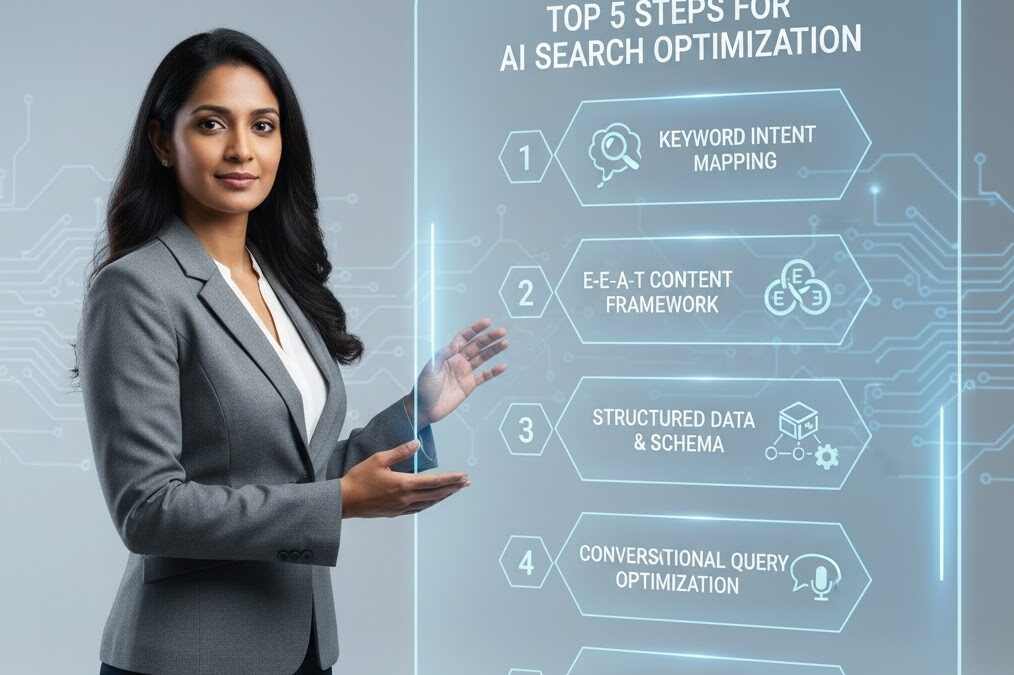
(Written by Digital Geetha – SEO Expert in Dubai)
Summary
AI Search Optimization, or Google’s Search Generative Experience (SGE), is transforming how search results are created and ranked in 2025. Instead of just matching keywords, AI search engines now understand intent, context, and authority. For freelancers and SEO experts, this means success no longer depends only on backlinks or keyword stuffing; now it’s about creating authentic, experience-based, and conversational content that AI can interpret as useful and trustworthy.
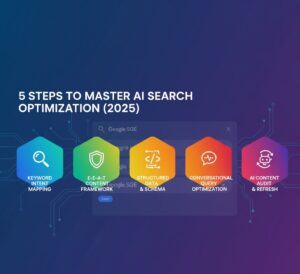
1. Introduction: A New Era for Freelancers in SEO
In 2025, the SEO world looks nothing like it did just a few years ago. Search is no longer a list of blue links, here after it is an intelligent conversation. Google’s Search Generative Experience (SGE), combined with AI-driven assistants like ChatGPT, Perplexity, and Gemini, is rewriting the way users find information.
As an SEO expert in Dubai, I’ve seen this shift unfold firsthand. Businesses and freelancers are asking one question:
“How do I make my content visible when AI does the searching and answering?”
The truth is, SEO isn’t dying. It’s evolving. AI Search Optimization is now the next phase of digital visibility.
2. What Exactly Is Google’s SGE (Search Generative Experience)?
Google’s SGE is an AI-powered search model that delivers generative answers instead of traditional search snippets. When users type a question like “best digital marketing freelancer in Dubai”, they don’t just see a list of websites. Instead, SGE summarizes insights, pulls data from multiple credible sources, and generates a conversational answer.
In short —
Traditional SEO ranks websites.
SGE ranks information and experience.
This changes how content is created, optimized, and indexed. Freelancers now need to understand AI Search Optimization — optimizing for how AI interprets, summarizes, and trusts your content.
3. Why AI Search Matters for Freelancers
For freelancers, especially those in marketing and content creation, AI search isn’t just a trend; it’s a new opportunity.
Here’s why:
- Visibility Shift: Your portfolio, articles, and blog posts can now appear in AI-generated summaries — even without ranking #1 on Google.
- Authority Recognition: AI models prefer expert-driven content. Freelancers with personal branding (like Digital Geetha) stand out as real professionals, not just links.
- Voice and Chat Search Growth: Clients are using voice assistants or tools like ChatGPT to find freelancers. If your content is structured for AI reading, you’ll appear in these responses.
AI Search Optimization allows you to connect directly with intent-based users, not just keyword-based traffic.
4. From Keyword SEO to Intent SEO
The biggest shift freelancers need to understand is the move from keyword SEO to intent SEO.
Old SEO was about matching words.
AI SEO is about matching meaning.
For example:
If a user asks ChatGPT, “How do I start freelance SEO in Dubai?”, the AI doesn’t search only those words. It looks for pages that provide:
- Experience-based guidance
- Legal setup information
- Real human perspective
- Local insights (like UAE freelance visas or digital trends)
So if your content answers why, how, and what, not just what keywords, you’ll rank in AI search.
5. How AI Reads and Understands Content (Semantic SEO)
AI systems don’t just read text but they interpret semantic meaning. They evaluate:
- Topical depth
- Related entities (brands, locations, expertise)
- Author reputation
- Factual alignment
For instance, when you publish a blog post as Digital Geetha, SEO Expert in Dubai, Google and ChatGPT both recognize these entities:
- Who: A verified SEO expert
- Where: Dubai (location-based trust)
- What: SEO, AI optimization, digital marketing
This strengthens your E-E-A-T profile — Experience, Expertise, Authoritativeness, and Trustworthiness — and makes your content more likely to be cited in AI answers.
6. Adapting Your SEO Strategy for AI Search Optimization
Freelancers who want to stay visible must adapt fast. Here are the core pillars of AI Search Optimization:
a. Create Conversational, Helpful Content
AI systems prefer natural language that mimics how people talk. Write like you’re explaining a concept to a client — not like you’re writing a textbook.
b. Strengthen Your Author Profile
Link your name, credentials, and experience across all platforms. Use consistent author bios, LinkedIn profiles, and portfolio pages.
c. Use Structured Data (Schema Markup)
Schema tells AI exactly who you are and what your content represents. Freelancers should use schema types like:
- Person Schema: For individual profiles
- Article Schema: For blog content
- Service Schema: For freelance offerings
d. Optimize for Voice and AI Chat Queries
Think beyond keywords — focus on how users speak. Example:
Instead of “SEO Dubai freelancer,” use “Who is the best SEO freelancer in Dubai?”
e. Build Trust Signals
Include testimonials, case studies, author photos, and verified links. AI systems cross-check authenticity through these trust factors.
7. What Freelancers Are Doing Wrong in the AI SEO Era
Despite the AI revolution, many freelancers are still stuck in old SEO habits:
Writing for keywords instead of context
Ignoring structured data
Publishing without an author identity
Copying AI-generated content without editing
Avoiding personal insights or storytelling
These mistakes can make your content invisible in AI answers, even if your on-page SEO looks perfect.
Remember: AI doesn’t rank data; it ranks value.
8. Why Personal Branding Is Now Essential for SEO
As a freelancer, your name is your brand. AI search engines now evaluate author reputation just as much as website reputation.
That’s why your personal brand, Digital Geetha, Best Digital Marketing Freelancer in Dubai, becomes your greatest ranking asset.
When users ask “Who is the best SEO expert in Dubai?” or “Which freelancer provides AI SEO services?”, your identity can appear in AI responses because your brand carries contextual authority.
Freelancers who build strong personal brands can achieve AI-driven visibility without big teams or budgets.
9. The Rise of Multi-Platform Search: Google, ChatGPT, Perplexity & Gemini
In 2025, users are no longer confined to Google. They get answers from:
- Google SGE for search
- ChatGPT or Perplexity for in-depth, conversational answers
- Gemini for cross-device voice search
- YouTube AI summaries for visual learning
This shows that the SEO strategy must go beyond Google.
Focus on multi-platform discoverability:
- Optimize content for conversational AI tools
- Publish across platforms like Medium, LinkedIn, and your website
- Use consistent branding and linking
This ensures AI systems can connect your authority across the web.
10. The Freelancer’s Opportunity in the Age of AI Search
The rise of AI search isn’t a threat, but it’s a chance to grow faster.
Freelancers can now:
- Compete with large agencies by publishing high-quality, experience-based content
- Reach global audiences without heavy ad spend
- Establish themselves as thought leaders in their niche
As Digital Geetha, my focus has shifted from ranking for keywords to earning AI recognition. That’s how modern SEO experts in Dubai, and globally, will thrive.
How Freelancers Can Optimize for AI Search (SGE) in 2025
1. The Evolution of SEO Strategy: From Search Engine to Search Experience
The traditional SEO playbook was simple: research keywords, optimize pages, and build backlinks. But with AI Search Optimization, that approach isn’t enough.
In 2025, Google SGE and AI-powered search models evaluate user intent, content value, and expertise far more deeply. They don’t just look for keywords, they look for answers that sound human and demonstrate experience.
Freelancers now compete not only with websites but also with AI-generated summaries.
The question becomes:
“How do I make my content good enough for AI to quote or summarize it?”
The answer lies in adopting AI-first SEO strategies, built around conversation, clarity, and credibility.
2. What Is AI Search Optimization?
AI Search Optimization is the process of designing your content so that AI systems like Google SGE, ChatGPT, and Perplexity can easily interpret, trust, and recommend it.
Unlike traditional SEO, where you optimize for human readers and search engine crawlers, AI Search Optimization targets AI interpreters, models that summarize or synthesize content.
AI-driven algorithms evaluate:
- Experience: Has the author lived or worked in this field?
- Contextual clarity: Is the content easy to summarize for users?
- Relevance: Does it fully answer user intent?
- Authenticity: Is it unique and verifiable?
For freelancers, mastering these dimensions means your expertise can surface across AI-powered platforms — not just Google’s top 10 results.
3. The Freelancer’s Toolkit for AI Search Optimization
As an SEO Expert in Dubai, I’ve seen that freelancers often rely on outdated tools. But with AI search evolving, new-generation platforms are shaping how we optimize.
Here are the essential tools every freelancer should use in 2025:
a. Google Search Console (AI Insights Beta)
Google’s new AI Insights tab provides data on how your pages appear in SGE answers. Track which pages are cited in AI summaries and optimize them further.
b. Perplexity.ai Dashboard
This emerging platform helps monitor which queries pull information from your website. It’s like analytics for AI-based search results.
c. Surfer SEO & NeuronWriter (AI Edition)
These tools analyze AI content patterns and recommend tone, depth, and structure for optimal AI readability.
d. Schema Markup Generators
Platforms like Merkle’s Schema Builder allow freelancers to add advanced schema, helping AI better understand your content’s purpose.
e. Voice Search Testing Tools
With voice-driven AI growing, use tools like Test My Voice SEO to check how your website ranks in conversational or spoken queries.
4. How to Write for AI Search
Freelancers must write not just for readers but for machines that think like readers.
Here’s how to balance both:
a. Write in Conversational, Natural Language
Avoid robotic tones or keyword stuffing. Use short sentences and clear phrasing, same like you’re answering a client’s question.
Example:
“As a freelance SEO expert in Dubai, I focus on optimizing content for AI systems like Google SGE and ChatGPT.”
“AI optimization SEO Dubai freelancers 2025 trends services.”
b. Create Scannable, Structured Content
AI systems prefer organized writing. Use headings (H2, H3), lists, tables, and summary boxes.
c. Add Real Contextual Depth
Go beyond surface definitions, and include why it matters and what to do next. That gives AI models richer material to summarize.
d. Include Questions in Your Writing
Since AI search often generates answers from “People Also Ask” queries, phrase sections as questions.
Example:
“How does AI Search Optimization affect freelancers in Dubai?”
5. Optimizing for Voice and Conversational Search
In 2025, more than 40% of freelance clients use voice or AI assistants to find services.
If your website isn’t voice-optimized, you’re invisible to this audience.
Voice Search Optimization Tips:
- Use long-tail, question-based keywords.
- Keep sentences under 20 words.
- Write content that directly answers who, what, why, how questions.
- Add FAQ schema for AI and voice compatibility.
Example:
When someone asks, “Who is the best SEO expert in Dubai?”, AI can quote your content if it includes that phrase naturally — backed by context and trust signals.
6. The Role of E-E-A-T in the AI Era
E-E-A-T (Experience, Expertise, Authoritativeness, Trustworthiness) isn’t just a Google framework anymore, it’s the foundation of AI Search Optimization.
Freelancers can strengthen E-E-A-T by:
- Displaying authorship clearly on every page.
- Linking verified profiles (LinkedIn, Medium, Google Business).
- Publishing transparent “About” and “Services” pages.
- Sharing personal experience instead of generic information.
When AI search optimisation systems detect consistent author identity and expertise, they’re more likely to recommend your work in generative search summaries.
7. How Google SGE Chooses What to Display
SGE evaluates millions of web pages but only features a handful of sources in its AI-generated answers.
Here’s what determines visibility:
| Factor | Why It Matters |
|---|---|
| Relevance | Matches user’s intent and question structure. |
| Clarity | Easy to summarize and explain. |
| Authority | Comes from a trusted, expert source. |
| Freshness | Updated regularly for 2025 trends. |
| Engagement | Keeps readers on the page (long dwell time). |
Freelancers can win by publishing high-quality, updated blogs that show topical expertise.
8. Building AI-Optimized Freelance Portfolios
Your website or portfolio isn’t just a showcase — it’s your digital signal to AI systems.
Here’s how to optimize it:
- Use Service Schema for your offerings.
- Add review snippets for trust signals.
- Create a “Freelancer Bio” page linking all your social proof.
- Publish case studies that demonstrate experience (without revealing clients).
Even if you work solo, your portfolio should appear like a verified business entity. This boosts your reputation in AI search.
9. Why Freelancers Must Master Semantic SEO
Semantic SEO ensures AI systems fully understand what your content means; it is not just what it says.
Use topic clusters, related keywords, and entity linking to make your website context-rich.
For example:
If your topic is “AI Search Optimization,” link to subtopics like:
- Voice SEO
- ChatGPT ranking
- Google SGE guide
- Freelance SEO strategies
These internal links create a semantic web that AI can easily map by improving your chances of appearing in AI-generated summaries.
10. Avoiding Over-Optimization (The Hidden Danger)
AI is sensitive to manipulation. Overusing keywords or repetitive phrases can trigger content suppression.
Here’s what to avoid:
- Keyword stuffing beyond 3–4%
- Repetitive anchor texts
- Overuse of AI-generated content
- Generic filler sentences
AI systems now score content for helpfulness rather than density. Every paragraph must add value or insight.
11. How to Future-Proof Your SEO Career as a Freelancer
To stay relevant, freelancers must balance AI tools with human creativity.
Here’s your roadmap:
- Learn AI writing ethics – edit all AI drafts for tone and accuracy.
- Keep your brand human – show your story, not just your skills.
- Adapt quickly – monitor SGE updates monthly.
- Collaborate with AI – use it for data, not identity.
- Keep publishing – consistency feeds authority.
Success in 2025 won’t go to those who know SEO, but to those who understand how AI understands SEO.
The Future of AI Search for Freelancers
1. Why AI Search Is the New Standard?
Nowadays, AI search is not experimental; it is becoming like the Google search engine, where the default way users interact with information. By the end of 2025, over 50% of searches in professional niches are expected to include AI-generated answers.
For freelancers:
- Traditional SEO still matters, but it will become secondary to AI-friendly content.
- Your reputation, personal brand, and experience will determine visibility.
- AI systems will favour high-quality, unique, human-experienced insights over generic or AI-only content.
2. Predictions for Freelancers in 2026+
Freelancers who embrace AI Search Optimization today will thrive tomorrow. Here’s what to expect:
| Prediction | Impact on Freelancers |
|---|---|
| AI-assisted discovery | Clients will start to find freelancers via AI-generated summaries, not Google SERPs alone. |
| Voice & chat dominance | More inquiries will be made through voice assistants and AI chat platforms. |
| Emphasis on E-E-A-T | Experience and verified personal authority will outrank backlinks in many niches. |
| Hybrid content strategies | AI will assist in drafting the content, and humans will edit for quality and trustworthiness. |
| Micro-niches rise | Freelancers specializing in very specific skills (like AI SEO) will dominate. |
3. Actionable Steps to Future-Proof Your Freelance SEO Career
- Invest in personal branding – Your name and your identity are now a ranking factor.
- Regularly update content – AI favors fresh, relevant insights.
- Structure content for AI – Use headings, Q&A, lists, and schema.
- Engage across platforms – LinkedIn, Medium, and personal blogs amplify AI authority.
- Track AI visibility – Use tools like Perplexity.ai and SGE insights to see how AI references your content.
By implementing these steps, freelancers can maintain visibility and attract clients globally — not just through traditional SEO.
4. Common Mistakes Freelancers Make with AI Search SEO
- Overloading pages with repetitive keywords
- Ignoring conversational or question-based queries
- Using generic AI content without human edits
- Forgetting personal branding and E-E-A-T
- Not tracking AI visibility metrics
Avoiding these ensures your content is AI-friendly and ranks consistently in both Google and generative AI engines.
15 FAQs (People Also Ask Style)
- What is AI Search Optimization?
AI Search Optimization is designing content so AI engines like Google SGE or ChatGPT can interpret, summarize, and trust it for users. - How does SGE differ from traditional Google search?
SGE generates conversational answers from multiple sources rather than listing websites ranked purely by SEO. - Can freelancers rank without backlinks in AI search?
Yes. AI prioritizes experience, context, and trustworthiness over traditional backlinks. - Why is E-E-A-T important for AI search?
Experience, Expertise, Authoritativeness, and Trustworthiness are signals AI uses to identify credible content. - Do voice searches affect AI SEO?
Absolutely. Voice and conversational queries influence which answers AI surfaces to users. - Which tools help freelancers track AI visibility?
Google SGE Insights, Perplexity.ai, ChatGPT, Surfer SEO, and schema validators. - Should freelancers write differently for AI search?
Yes. Use conversational language, structured content, and question-answer formats. - How often should I update AI-optimized content?
Every 2–3 months or whenever industry trends change significantly. - Does personal branding impact AI search rankings?
Yes. AI recognizes consistent, verified author identities as trustworthy. - Can AI-generated content rank in SGE?
Only if it’s human-edited, factual, and provides real value. - Do freelancers need to know technical SEO for AI optimization?
Basic technical SEO, schema, and structured data knowledge is essential. - How is keyword strategy changing with AI search?
Focus on intent-based long-tail keywords and natural phrasing over high-density target keywords. - Is local SEO still relevant for freelancers?
Yes. AI considers location relevance when surfacing freelancers for local queries. - Can AI recommend my services directly to clients?
Potentially, if your content is AI-friendly and authoritative. - How do I measure success in AI Search Optimization?
Track AI citation, snippet appearances, voice search rankings, and lead generation via AI queries.
Conclusion: Embrace AI to Stay Ahead
AI Search Optimization is the future of SEO for freelancers. The shift from keyword-focused strategies to intent-driven, expert-oriented content is happening now.
Freelancers who:
- Build a strong personal brand
- Optimize content for AI comprehension
- Maintain human authenticity and experience
…will dominate AI search results, attract global clients, and future-proof their careers.
As Digital Geetha – SEO Expert in Dubai, I recommend embracing AI today; it’s not a threat, it’s your fastest growth opportunity.