
Summary
What is search intent?
Search intent is the reason behind a user’s search query. It explains why someone searches on Google and what type of answer they expect. Understanding search intent helps you create content that matches user needs, improves rankings, and increases engagement across Google, AI search engines, and voice search.
Introduction: Why Search Intent Decides Who Ranks and Who Doesn’t
SEO is no longer about stuffing keywords into content.
You can use the right keyword.
You can follow all technical SEO rules.
But if your content does not match search intent, it will not rank.
Google, AI search engines, and voice assistants are built to answer intent, not just keywords. That is why understanding what is search intent has become one of the most important SEO skills today.
In this guide, you will learn:
- What search intent really means
- Why it directly affects rankings
- How Google and AI systems understand intent
- How beginners can identify and use search intent correctly
This article is written so that even a 5th-grade student can understand it, but it is detailed enough for marketers, business owners, and SEO professionals.
What Is Search Intent?
Search intent is the goal a user has when they type a query into a search engine.
When someone searches on Google, they are not just typing words.
They are looking for:
- Information
- A specific website
- A comparison
- Or a solution they can buy or act on
Search intent answers one simple question:
“What does the user want right now?”
If your content gives the exact answer they want, Google rewards it with higher rankings.
A Simple Example to Understand Search Intent
Let’s look at three different searches:
- “What is SEO”
- “Best SEO tools”
- “Hire SEO expert”
All three include the word “SEO”.
But the intent is completely different.
- The first person wants to learn
- The second person wants to compare options
- The third person wants to take action
If you use the same content for all three, it will fail.
This is why search intent in SEO matters more than keywords alone.
Why Search Intent Is So Important for SEO
Search intent decides:
- Whether your page ranks
- How long users stay on your page
- Whether they convert or leave
- Whether AI engines choose your content as an answer
Google’s main goal is to give users the best possible answer for their intent. If your content does not match that intent, Google sees it as unhelpful.
This is also why many pages lose rankings even when their content looks “good”. The intent is wrong.
How Google Understands Search Intent
Google uses multiple signals to understand user intent, including:
- The wording of the query
- Search history and behavior patterns
- Click-through rates
- Time spent on pages
- SERP features like snippets, videos, and shopping results
For example:
- If most users click videos for a query, Google assumes video intent
- If users prefer guides, Google ranks long-form articles
- If users want to buy, Google shows product and commercial pages
Google learns from user behaviour at scale.
Search Intent vs Keywords: What’s the Difference?
Many beginners confuse keywords with intent.
Here is the difference:
- Keyword = the words typed into Google
- Search intent = the reason behind those words
Two people can use the same keyword with different intent.
Example:
- “Email marketing” could mean learning
- Or comparing tools
- Or hiring a service
SEO today is about intent-first optimization, not keyword-first writing.
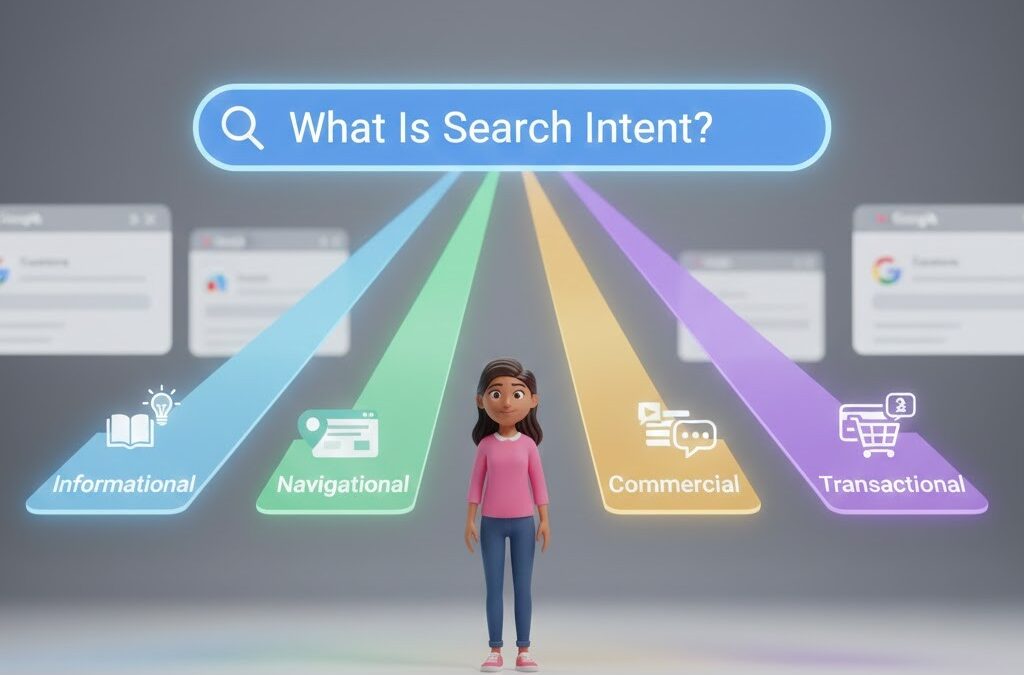
The 4 Main Types of Search Intent

To understand what is search intent, you must know its four core types.
1. Informational Intent
The user wants to learn something.
Examples:
- What is search intent
- How SEO works
- Why keywords matter
Content that works best:
- Blog posts
- Guides
- Tutorials
- Explainer articles
Your goal here is education, not selling.
The user wants to reach a specific website or brand.
Examples:
- Google Search Console login
- YouTube Studio
- Amazon customer service
Content that works best:
- Brand pages
- Homepages
- Login or support pages
You usually do not create content for these unless you own the brand.
3. Commercial Intent
The user is researching before making a decision.
Examples:
- Best SEO tools
- SEMrush vs Ahrefs
- SEO services pricing
Content that works best:
- Comparison articles
- Reviews
- Listicles
- Case studies
This intent is very valuable for businesses.
4. Transactional Intent
The user is ready to take action.
Examples:
- Buy SEO software
- Hire SEO freelancer
- SEO services near me
Content that works best:
- Landing pages
- Service pages
- Product pages
This intent directly drives revenue.
Why Many Websites Fail at Search Intent
Most websites fail because they:
- Target keywords without analyzing intent
- Use the same content format for every query
- Focus on traffic instead of usefulness
For example:
Writing a long blog post for a query that needs a product page will not rank.
Google sees this mismatch instantly.
Search Intent and AI Search Engines
AI systems like ChatGPT, Perplexity, and Gemini do not work like traditional search.
They:
- Understand context
- Summarize multiple sources
- Prefer clear, intent-matched content
If your article clearly answers what is search intent, with structure and clarity, AI engines are more likely to surface it as a trusted answer.
That is why intent-based content is critical for AI visibility.
How Voice Search Changes Search Intent
Voice search queries are:
- Longer
- More conversational
- Intent-driven
Example:
Instead of “search intent”, users say:
“What is search intent in SEO and why does it matter?”
Voice search makes intent even more obvious.
Your content must sound natural and answer questions directly.
Search Intent Is the Foundation of Modern SEO
SEO in 2026 is not about tricks or hacks.
It is about:
- Understanding people
- Understanding their needs
- Delivering the right answer at the right moment
When you understand what is search intent, everything else in SEO becomes easier:
- Keyword research
- Content creation
- Conversion optimization
- AI and voice search visibility
How to Identify Search Intent Step by Step
Understanding what is search intent is one thing. Applying it correctly is what separates ranking content from content that never gets traffic.
Here is a simple step-by-step method anyone can follow.
Step 1: Look at the Exact Search Query
Start with the words used in the search.
Ask:
- Is the user asking a question?
- Are they comparing options?
- Are they ready to buy or take action?
Examples:
- “What is search intent” → learning
- “Search intent examples” → learning + clarification
- “SEO keyword intent tools” → research
- “Hire SEO consultant” → action
The wording already gives strong clues.
Step 2: Analyze the Google Search Results (SERPs)
Google already tells you what it thinks the intent is.
Search the keyword and observe:
- Are the top results blogs or landing pages?
- Are there videos, featured snippets, or FAQs?
- Are products or ads dominant?
For what is search intent, you will usually see:
- Educational blog posts
- Beginner-friendly guides
- Explainer content
That confirms informational intent.
Step 3: Check SERP Features
SERP features reveal intent clearly.
Look for:
- Featured snippets → users want quick answers
- People Also Ask → question-based intent
- Videos → visual learning intent
- Shopping results → transactional intent
If Google shows a featured snippet, your content must answer the question clearly and early.
Step 4: Study User Behaviour Signals
Google tracks how users behave after clicking.
Important signals include:
- Time on page
- Bounce rate
- Scroll depth
- Return to search results
If users leave quickly, it means the intent was not satisfied.
Matching search intent keeps users engaged, which improves rankings.
How to Map Search Intent to Content Types
Once you identify intent, you must match it with the right content format.
Here is a simple mapping guide.
Informational Intent → Educational Content
Best formats:
- Blog posts
- How-to guides
- Explainers
- Tutorials
Example:
“What is search intent” works best as a clear, structured article.
Best formats:
- Homepage
- Login pages
- Support pages
You usually do not create content for this unless you own the brand.
Commercial Intent → Comparison Content
Best formats:
- Best-of lists
- Tool comparisons
- Reviews
- Case studies
Example:
“Best keyword research tools” needs comparisons and pros and cons.
Transactional Intent → Conversion Pages
Best formats:
- Service pages
- Product pages
- Landing pages
Example:
“Hire SEO freelancer” needs pricing, benefits, and CTAs.
Common Search Intent Mistakes (And How to Fix Them)
Many websites lose rankings because of these mistakes.
Mistake 1: Writing Blogs for Buying Keywords
If a keyword shows:
- Ads
- Pricing pages
- Service pages
Then a blog post will struggle to rank.
Fix:
Create a dedicated landing or service page.
Mistake 2: Targeting Multiple Intents on One Page
Trying to teach, sell, and compare on one page confuses users.
Fix:
One page = one primary intent.
Mistake 3: Ignoring SERP Changes
Search intent evolves.
A keyword that was informational last year may become commercial today.
Fix:
Re-check SERPs every few months.
Search Intent and Keyword Research
Keyword research without intent analysis is incomplete.
When doing keyword research:
- Group keywords by intent
- Create content clusters around intent
- Avoid mixing intent types
For example:
- Informational cluster: What is search intent, types of search intent
- Commercial cluster: Search intent tools, keyword intent software
- Transactional cluster: SEO services, consulting pages
This approach builds topical authority.
Search Intent in Content Writing
Every section of your content should support intent.
For informational intent:
- Use clear definitions
- Add examples
- Avoid sales language
For commercial intent:
- Provide comparisons
- Show use cases
- Explain benefits
For transactional intent:
- Be direct
- Remove distractions
- Focus on action
This alignment improves conversions and rankings.
Search Intent and AI Ranking Systems
AI engines prioritize:
- Clear answers
- Logical structure
- Intent-focused explanations
They prefer content that:
- Answers the main question early
- Uses simple language
- Stays focused on one intent
This is why intent-based articles perform better in AI answers and summaries.
How Search Intent Improves Conversion Rates
When intent is matched:
- Users trust your content
- They stay longer
- They take action naturally
SEO traffic becomes meaningful traffic.
Ranking is not the goal.
Solving user problems is.
Search Intent Is a Long-Term SEO Advantage
Algorithms change.
Search intent does not.
Understanding what is search intent helps you:
- Create evergreen content
- Adapt to AI-driven search
- Future-proof your SEO strategy
Advanced Search Intent Strategies That Top-Ranking Pages Use
Understanding what is search intent is not enough anymore. To rank consistently, you must go deeper.
1. One Primary Intent Per Page
Top-ranking pages focus on one dominant intent.
If the keyword intent is informational:
- Do not push sales
- Do not add aggressive CTAs
- Focus on clarity and explanation
This is why educational content ranks higher for definition-based queries.
2. Match Content Depth With Intent Strength
Not all informational searches need long content.
Examples:
- “What is search intent” → detailed explanation
- “Search intent meaning” → short, clear definition
Analyze the SERP to decide depth, not assumptions.
3. Use Intent Modifiers in Headings
Words that reinforce intent:
- Learn, understand, explained (informational)
- Best, compare, review (commercial)
- Buy, hire, pricing (transactional)
This helps both users and AI systems understand your content focus.
4. Refresh Content When Intent Shifts
Search intent changes over time.
A keyword that once showed blogs may now show tools or services.
Action step:
- Recheck SERPs every 3–6 months
- Update content type if needed
5. Build Intent-Based Content Clusters
Instead of random blogs, create clusters.
Example cluster:
- What is search intent
- Types of search intent
- How to identify search intent
- Search intent examples
- Search intent tools
This improves topical authority and internal linking.
25 FAQs About Search Intent (People Also Ask Style)
1. What is search intent in SEO?
Search intent is the reason behind a user’s search. It explains what the user wants to achieve when typing a query into a search engine.
2. Why is search intent important for SEO?
Search intent helps Google rank content that best satisfies users. Pages that match intent rank higher and get better engagement.
3. What are the main types of search intent?
The four main types are informational, navigational, commercial, and transactional.
4. How does Google identify search intent?
Google analyzes keywords, SERP patterns, user behavior, and engagement signals to determine intent.
5. What is informational search intent?
Informational intent means the user wants to learn or understand something.
6. What is transactional search intent?
Transactional intent means the user wants to buy, sign up, or take immediate action.
7. What is commercial search intent?
Commercial intent means the user is researching before making a purchase decision.
Navigational intent is when users want to reach a specific website or platform.
9. How do I identify search intent for a keyword?
Check the keyword wording and analyze the top-ranking Google results.
10. Can one keyword have multiple search intents?
Yes, but usually one intent dominates. Always optimize for the primary intent.
11. What happens if content does not match search intent?
It may rank briefly but will drop due to poor user engagement.
12. How does search intent affect rankings?
Matching intent improves dwell time, reduces bounce rate, and increases trust signals.
13. Is search intent more important than keywords?
Yes. Keywords bring traffic, but intent determines whether content ranks and converts.
14. How does search intent affect conversions?
When intent is matched, users naturally take action without pressure.
15. What tools help analyze search intent?
Google Search, SERP analysis, and keyword research tools help identify intent.
You can also refer to Google’s official guidance on search behaviour
16. Does search intent matter for AI search engines?
Yes. AI systems prioritize clear intent alignment and structured answers.
17. How does search intent help voice search?
Voice searches are intent-heavy and usually informational or transactional.
18. Should blogs target transactional keywords?
No. Blogs perform best with informational or commercial intent.
19. Can search intent change over time?
Yes. Trends, technology, and user behavior influence intent changes.
20. How often should I review search intent?
Every 3 to 6 months for important keywords.
21. Does search intent affect featured snippets?
Yes. Featured snippets usually appear for informational intent queries.
22. How does search intent support E-E-A-T?
Intent-matched content improves experience, trust, and usefulness.
23. Is search intent important for beginners?
Absolutely. It is the foundation of modern SEO.
24. Where can I learn more about search intent?
Trusted SEO resources like Moz explain intent-based optimization in detail
25. How can I practice search intent optimization?
Start by analyzing SERPs and creating one clear page for one clear intent.
Conclusion: Why Search Intent Decides SEO Success
Search intent is no longer optional.
It is the deciding factor behind rankings, traffic quality, and conversions.
If your content:
- Matches what users want
- Answers questions clearly
- Follows intent-based structure
Then Google and AI systems will reward it.
If you are new to SEO or want to strengthen your foundation, start here:
Learn the fundamentals in this beginner-friendly guide:
SEO Basics for Beginners
https://digitalgeetha.com/seo-basics-for-beginners/
If you want your content to rank, convert, and stay future-proof, stop guessing keywords and start optimizing for search intent.
Follow Digital Geetha for practical SEO strategies that work for Google, AI search, and real users.