

Contents
- 1 Introduction: Why Most People Are Using AI the Wrong Way
- 2 What Is AI Role Prompting
- 3 Why AI Role Prompting Matters More in 2025
- 4 Chatbot Thinking vs AI Team Thinking
- 5 How AI Role Prompting Works in Practice
- 6 Examples of AI Role Prompting
- 7 Why AI Role Prompting Produces Better SEO Content
- 8 AI Role Prompting and AI Overviews
- 9 How Businesses Can Use AI Role Prompting
- 10 Building an AI Team Using Role Prompting
- 11 Common Mistakes in AI Role Prompting
- 12 Best Practices for AI Role Prompting
- 13 AI Role Prompting for Small Businesses
- 14 AI Role Prompting Is a Skill, Not a Trick
- 15 The Future of AI Role Prompting
- 16 25 Frequently Asked Questions
- 16.1 1. What is AI Role Prompting
- 16.2 2. Why is AI Role Prompting important
- 16.3 3. Is role-based prompting only for marketers
- 16.4 4. Does AI Role Prompting improve SEO
- 16.5 5. Can beginners use role-based prompting
- 16.6 6. How long should a role prompt be
- 16.7 7. Can role-based prompting help small businesses
- 16.8 8. Is AI Role Prompting better than templates
- 16.9 9. Does role-based prompting work with all AI tools
- 16.10 10. Can role-based prompting replace human teams
- 16.11 11. How does role-based prompting affect content quality
- 16.12 12. Is AI Role Prompting useful for ads
- 16.13 13. Does role-based prompting help with AI Overviews
- 16.14 14. Can role-based prompting be reused
- 16.15 15. Is role-based prompting ethical
- 16.16 16. How does role-based prompting compare to prompt engineering
- 16.17 17. Can role-based prompting improve productivity
- 16.18 18. Does Google penalize AI-generated content
- 16.19 19. Is AI Role Prompting supported by SEO experts
- 16.20 20. Can role-based prompting help with strategy
- 16.21 21. Does AI Role Prompting reduce hallucinations
- 16.22 22. How often should role prompts be updated
- 16.23 23. Is role-based prompting suitable for agencies
- 16.24 24. Can AI Role Prompting be taught to teams
- 16.25 25. Is role-based prompting the future of AI usage
- 17 Conclusion: Build Systems, Not Shortcuts
Summary
AI Role Prompting is a structured approach to using artificial intelligence by assigning clear roles, responsibilities, and context instead of asking random questions. This method helps businesses, marketers, and creators get higher-quality, more consistent, and goal-driven outputs from AI tools. By treating AI like a team member rather than a chatbot, AI Role Prompting improves productivity, decision-making, content quality, and scalability across marketing, SEO, operations, and strategy.
Introduction: Why Most People Are Using AI the Wrong Way
Most people still use AI the same way they used Google for years.
They type a question, skim the answer, and move on.
This approach creates the illusion of productivity but delivers very little leverage.
AI is not a search engine. It is a thinking system. But it only thinks as well as the instructions it is given.
This is where AI Role Prompting changes everything.
Instead of asking AI what to do, you tell it who it is. You define how it should think, what it should prioritize, and what it should ignore. The result is sharper outputs, fewer revisions, and consistent quality that feels like working with a trained assistant rather than a chatbot.
What Is AI Role Prompting
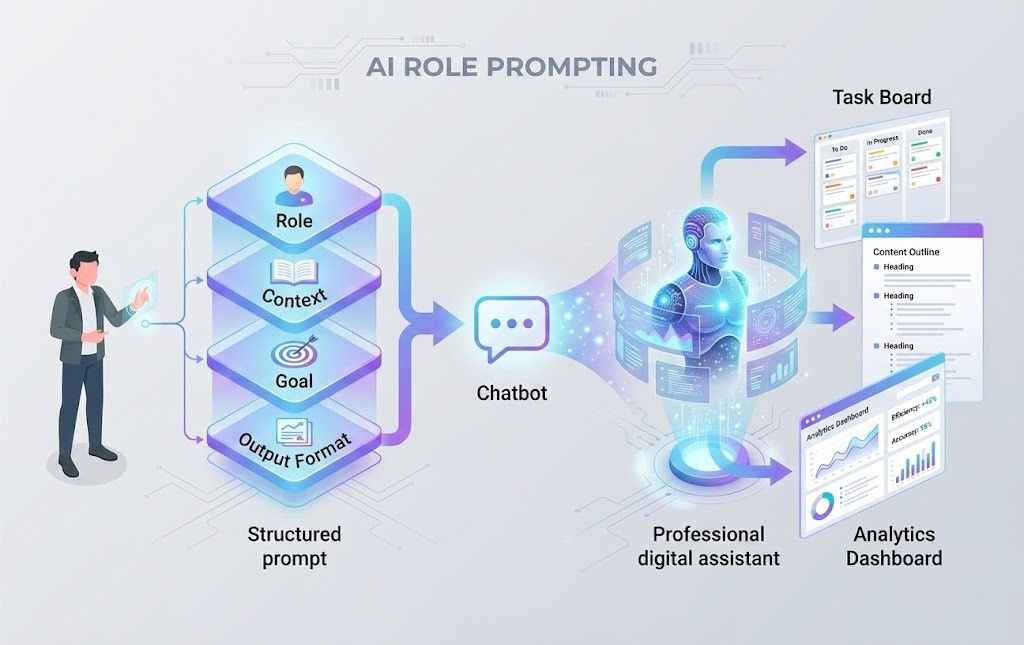
AI Role Prompting is the practice of assigning a specific professional role to an AI before giving it a task.
Instead of saying:
Write a blog post about SEO
You say:
Act as a senior SEO strategist with experience ranking competitive keywords and writing content optimized for Google and AI search. Write a blog post about SEO trends for 2025.
The second prompt immediately changes the depth, structure, and relevance of the output.
AI Role Prompting provides context. Context is what separates generic answers from expert-level responses.
Why AI Role Prompting Matters More in 2025
Search behavior, content creation, and business workflows have changed.
AI is now used for:
- Content creation
- SEO strategy
- Marketing campaigns
- Data analysis
- Customer support
- Decision support
As AI adoption increases, average outputs flood the internet. The people who stand out are not those using AI more, but those using it better.
AI Role Prompting is how professionals:
- Maintain quality
- Avoid generic content
- Build repeatable workflows
- Scale without losing control
This is also why AI-generated content that lacks structure fails to rank or convert.
Chatbot Thinking vs AI Team Thinking
When people treat AI like a chatbot, they expect instant answers with no setup. This leads to shallow outputs and inconsistent results.
When people treat AI like a team member, they:
- Define responsibilities
- Set expectations
- Provide context
- Review outputs strategically
This shift changes AI from a tool into a system.
A chatbot answers questions.
An AI team executes objectives.
How AI Role Prompting Works in Practice
It has three core components:
1. Role Definition
You define who the AI is acting as.
Examples:
- SEO strategist
- Performance marketer
- UX writer
- Business analyst
- Startup consultant
2. Context and Constraints
You define the environment.
Examples:
- Target audience
- Industry
- Goals
- Platforms
- Tone and depth
3. Clear Output Expectations
You define what success looks like.
Examples:
- Length
- Format
- Metrics
- Use cases
Together, these components guide AI decision-making.
Examples of AI Role Prompting
Example 1: SEO Content
Without role prompting:
Write a blog on AI and SEO.
With AI Role Prompting:
Act as an SEO consultant who specializes in AI-powered search. Write a long-form blog optimized for Google and AI Overviews on how AI is changing SEO.
The second output is structured, strategic, and searchable.
Example 2: Marketing Strategy
Without role prompting:
Create a marketing plan.
With role-based prompting:
Act as a growth marketer managing a monthly budget of $50,000. Create a 90-day marketing plan focused on lead generation and ROI.
The AI now thinks in numbers, priorities, and outcomes.
Example 3: Client Communication
Without role prompting:
Write a follow-up email.
With role-based prompting:
Act as a senior account manager handling premium clients. Write a professional follow-up email that balances urgency with relationship-building.
The tone and structure immediately improve.
Why AI Role Prompting Produces Better SEO Content
Search engines reward:
- Clarity
- Structure
- Intent alignment
- Depth
- Authority signals
AI Role Prompting naturally produces content that aligns with these factors because it forces the AI to think like a specialist.
This improves:
- Content relevance
- Topical coverage
- User satisfaction
- AI search summarization
This is why role-based content performs better in both traditional search and AI-powered search experiences.
AI Role Prompting and AI Overviews
AI-powered search systems summarize content based on clarity, structure, and authority.
Role-prompted content:
- Answers questions directly
- Covers topics comprehensively
- Avoids fluff
- Uses logical progression
This increases the chances of being referenced or summarized in AI-generated answers.
How Businesses Can Use AI Role Prompting
AI Role Prompting is not just for creators. It applies across departments.
Marketing Teams
- Content planning
- Ad copy creation
- Funnel optimization
SEO Teams
- Keyword clustering
- Content briefs
- Technical explanations
Operations
- SOP creation
- Process documentation
- Workflow optimization
Founders and Leaders
- Strategy validation
- Decision modeling
- Market analysis
When AI roles are consistent, outputs become predictable and scalable.
Building an AI Team Using Role Prompting
Instead of one generic AI, you can create multiple role-based prompts:
- SEO Strategist AI
- Content Editor AI
- Ad Copy Specialist AI
- Data Analyst AI
Each role has its own instructions and expectations.
This mirrors how real teams work and reduces cognitive load.
Common Mistakes in AI Role Prompting
Being Too Vague
Roles like “marketing expert” are too broad. Specificity improves results.
Overloading Instructions
Too many rules can confuse the AI. Clarity matters more than volume.
Not Iterating
Role prompts improve over time. Treat them as evolving assets.
Best Practices for AI Role Prompting
- Use real-world job titles
- Define experience level
- Set goals clearly
- Specify audience and platform
- Reuse successful role prompts
These practices turn AI into a reliable system.
AI Role Prompting for Small Businesses
Small businesses benefit the most from role-based promptingbecause it reduces dependency on large teams.
With the right roles, a small business owner can:
- Plan content
- Optimize SEO
- Write emails
- Analyze performance
This levels the playing field.
AI Role Prompting Is a Skill, Not a Trick
It is not about gaming AI.
It is about:
- Clear thinking
- Structured communication
- Strategic intent
These skills transfer to leadership, marketing, and decision-making.
The Future of AI Role Prompting
As AI tools evolve, prompting will become less about commands and more about systems.
People who understand AI Role Prompting today will be better positioned to:
- Build AI workflows
- Train internal AI systems
- Adapt to future AI interfaces
25 Frequently Asked Questions
1. What is AI Role Prompting
It is assigning a specific professional role to AI before giving it tasks.
2. Why is AI Role Prompting important
It improves output quality, relevance, and consistency.
3. Is role-based prompting only for marketers
No, it works for business, operations, education, and strategy.
4. Does AI Role Prompting improve SEO
Yes, it helps create structured, intent-aligned content.
5. Can beginners use role-based prompting
Yes, it actually helps beginners get expert-level outputs faster.
6. How long should a role prompt be
Long enough to define context, short enough to stay clear.
7. Can role-based prompting help small businesses
Yes, it allows small teams to scale intelligently.
8. Is AI Role Prompting better than templates
Yes, because it adapts thinking, not just formatting.
9. Does role-based prompting work with all AI tools
Most modern AI tools respond well to role-based prompts.
10. Can role-based prompting replace human teams
No, it enhances human decision-making, not replaces it.
11. How does role-based prompting affect content quality
It improves depth, clarity, and authority.
12. Is AI Role Prompting useful for ads
Yes, especially for audience and tone alignment.
13. Does role-based prompting help with AI Overviews
Yes, structured content performs better in AI summaries.
14. Can role-based prompting be reused
Yes, successful role prompts should be reused and refined.
15. Is role-based prompting ethical
Yes, it improves clarity and responsible use of AI.
16. How does role-based prompting compare to prompt engineering
It is a practical subset focused on thinking roles.
17. Can role-based prompting improve productivity
Yes, by reducing revisions and confusion.
18. Does Google penalize AI-generated content
No, Google evaluates quality, not how content is created. You can refer to Google Search Central guidelines here: https://developers.google.com/search/docs/fundamentals/creating-helpful-content
19. Is AI Role Prompting supported by SEO experts
Yes, many SEO experts recommend structured AI usage. Ahrefs discusses AI-assisted content creation here: https://ahrefs.com/blog/ai-content/
20. Can role-based prompting help with strategy
Yes, it is especially powerful for strategic thinking.
21. Does AI Role Prompting reduce hallucinations
Clear roles reduce ambiguity and errors.
22. How often should role prompts be updated
Whenever goals or markets change.
23. Is role-based prompting suitable for agencies
Yes, it standardizes outputs across teams.
24. Can AI Role Prompting be taught to teams
Yes, it should be part of AI training.
25. Is role-based prompting the future of AI usage
Yes, structured AI usage will define long-term success.
Conclusion: Build Systems, Not Shortcuts
It is not about getting faster answers.
It is about building systems that think, adapt, and scale with you.
When you stop treating AI like a chatbot and start treating it like a team, the results change completely.
If you want to implement role-based prompting into your SEO, marketing, or content workflows, explore more practical frameworks here: Digital Marketing freelancer in Dubai
This is how you move from using AI occasionally to leveraging it strategically.