
Contents
- 1 Featured Summary
- 2 Introduction: Why Google Ads and Performance Marketing Matter Today
- 3 Understanding the Role of a Google Ads and Performance Marketing Specialist
- 4 Step One: Building Strong Fundamentals
- 5 Step Two: Structured Learning and Certification
- 6 Step Three: Moving from Theory to Practice
- 7 About the Brand: Trip Kerala Tours
- 8 Campaign Objective and Performance Focus
- 9 Keyword Strategy: The Backbone of Performance
- 10 Structuring the Google Ads Account
- 11 Writing Ads That Convert
- 12 Using Ad Extensions Effectively
- 13 Performance Tracking and Metrics
- 14 Optimization: The Daily Work of a Specialist
- 15 Skills Developed Through This Journey
- 16 Trust, Accountability, and E-E-A-T
- 17 What Makes a Successful Google Ads and Performance Marketing Specialist
- 18 Transitioning Toward Advanced Performance Marketing
- 19 Moving Beyond Basics: Thinking Like a Performance Marketer
- 20 Understanding the Full Funnel in Google Ads
- 21 Conversion Tracking: The Backbone of Performance Marketing
- 22 Reading Google Ads Data the Right Way
- 23 Smart Bidding and Budget Control
- 24 Improving Quality Score for Long-Term Success
- 25 Ad Copy Testing That Actually Works
- 26 Landing Page Optimization and CRO Basics
- 27 Audience and Location Optimization
- 28 Scaling Campaigns Without Losing Control
- 29 Reporting and Performance Communication
- 30 Handling Common Google Ads Challenges
- 31 Tools That Support Performance Marketing
- 32 Building Confidence Through Results
- 33 Continuous Learning in Google Ads
- 34 Frequently Asked Questions (FAQs)
- 34.1 1. What does a Google Ads and Performance Marketing Specialist do?
- 34.2 2. Is Google Ads certification enough to become a specialist?
- 34.3 3. How long does it take to learn Google Ads properly?
- 34.4 4. Why is performance marketing different from digital marketing?
- 34.5 5. What skills are required for performance marketing?
- 34.6 6. How important is keyword research in Google Ads?
- 34.7 7. What is Quality Score in Google Ads?
- 34.8 8. How do negative keywords help campaigns?
- 34.9 9. What budget is needed to start Google Ads?
- 34.10 10. Can small businesses benefit from Google Ads?
- 34.11 11. What tools does a Google Ads and Performance Marketing Specialist use?
- 34.12 12. How is campaign success measured?
- 34.13 13. Is Google Ads suitable for service businesses?
- 34.14 14. How often should campaigns be optimized?
- 34.15 15. What mistakes should beginners avoid?
- 34.16 16. How does landing page quality affect Google Ads?
- 34.17 17. Is smart bidding always recommended?
- 34.18 18. Can Google Ads work internationally?
- 34.19 19. How do you reduce high CPC?
- 34.20 20. What industries perform well with Google Ads?
- 34.21 21. How do you build trust with clients?
- 34.22 22. Is performance marketing a good career?
- 34.23 23. How do you stay updated with Google Ads changes?
- 34.24 24. Can Google Ads be combined with SEO?
- 34.25 25. What makes a great Google Ads and Performance Marketing Specialist?
- 35 Final Conclusion and Call to Action
Featured Summary
Becoming a Google Ads and Performance Marketing Specialist is a journey built on learning, testing, failing, optimizing, and scaling real campaigns. This article shares a practical, experience-driven path from fundamentals to advanced performance marketing, including hands-on Google Ads execution for a real travel brand, Trip Kerala Tours. It explains skills, mindset, tools, and strategies required to grow into a results-focused performance marketer trusted by businesses.
Introduction: Why Google Ads and Performance Marketing Matter Today
Digital marketing has changed fast. Businesses no longer want likes or impressions alone. They want leads, sales, and measurable growth. This shift is why the role of a Google Ads and Performance Marketing Specialist has become so important.
A performance marketer focuses on results. Every click, keyword, and conversion is tracked. Decisions are made using data, not guesswork. Google Ads plays a major role because it connects businesses with people who already have buying intent.
My journey toward becoming a Google Ads and Performance Marketing Specialist did not happen overnight. It was built step by step through structured learning, certification, and real campaign execution.
This article documents that journey in a practical way so beginners, business owners, and marketers can understand what it truly takes to grow into this role.

Understanding the Role of a Google Ads and Performance Marketing Specialist
A Google Ads and Performance Marketing Specialist is responsible for planning, launching, optimizing, and scaling paid campaigns that deliver measurable business outcomes.
Core Responsibilities
- Keyword research and intent mapping
- Campaign structure and account setup
- Writing high-converting ad copy
- Budget planning and bid strategy
- Conversion tracking and analytics
- Ongoing optimization and scaling
Unlike general digital marketing, performance marketing is deeply analytical. Every action is tracked, reviewed, and improved.
Step One: Building Strong Fundamentals
Every successful Google Ads and Performance Marketing Specialist starts with fundamentals. Without strong basics, advanced strategies fail.
Learning How Google Ads Works
The first step is understanding how Google Ads functions:
- Search auctions
- Quality Score
- Ad Rank
- Keyword match types
- Cost-per-click (CPC)
- Click-through rate (CTR)
- Conversion rate
Understanding these concepts helps you see why some ads perform better than others.
Knowing User Intent
Intent is the heart of performance marketing. A good specialist learns to separate:
- Informational intent
- Commercial intent
- Transactional intent
For example, someone searching “Kerala couple tour package” has strong buying intent. This knowledge directly impacts keyword selection and ad copy.
Step Two: Structured Learning and Certification
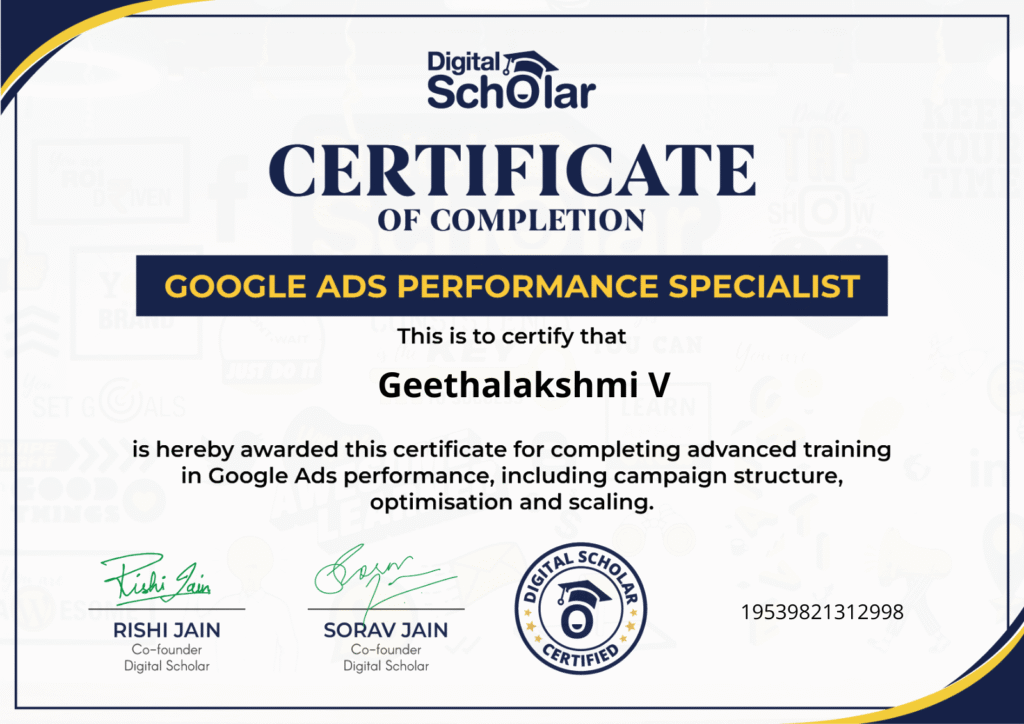
Formal training helped shape my understanding into a system. Completing advanced training in Google Ads performance provided clarity on how professional campaigns are built.
Value of Certification
A certification is not just a document. It represents:
- Verified knowledge of Google Ads
- Exposure to best practices
- Confidence to manage real ad budgets
The certification process covered campaign structure, optimization, and scaling, which are essential skills for any Google Ads and Performance Marketing Specialist.
Step Three: Moving from Theory to Practice
Learning becomes meaningful only when applied. This transition is where most beginners struggle.
Working on a Real Brand: Trip Kerala Tours
Hands-on experience came through executing Google Ads campaigns for Trip Kerala Tours, a well-established travel brand offering authentic Kerala travel experiences.
This project moved learning from theory to real-world performance marketing.
About the Brand: Trip Kerala Tours
Trip Kerala Tours is a travel company established in 1995, known for curated Kerala travel experiences. The brand focuses on couples, families, and travelers looking for authentic local experiences.
This made it an ideal case study for applying Google Ads and performance marketing strategies.
Campaign Objective and Performance Focus
The main objective was clear:
- Generate high-quality leads
- Attract users with booking intent
- Control ad spend while maximizing ROI
This clarity is essential for any Google Ads and Performance Marketing Specialist.
Keyword Strategy: The Backbone of Performance
Keyword research defined the success of the campaign.
Primary Keywords Used
- Kerala couple tour package
- Romantic Kerala trip
- Best Kerala couple package
These keywords showed strong transactional intent.
Negative Keywords Strategy
Negative keywords were equally important to reduce wasted spend:
- Free
- Jobs
- Train
- Bus
- Cheap
- College tour
This helped improve CTR and lower CPC.
Structuring the Google Ads Account
A clean structure improves Quality Score and performance.
Campaign Structure Best Practices
- Separate campaigns by intent
- Tight keyword grouping
- Clear ad-to-landing page relevance
This structure is a core skill for any Google Ads and Performance Marketing Specialist.
Writing Ads That Convert
Ad copy was written with clarity and intent.
Key Ad Copy Principles
- Match search intent
- Highlight benefits
- Use emotional triggers
- Include clear call-to-action
Travel ads focused on romance, experience, and trust rather than price alone.
Using Ad Extensions Effectively
Extensions improve visibility and trust.
Extensions Implemented
- Sitelink extensions
- Callout extensions
- Location extensions
These increased ad real estate and improved CTR.
Performance Tracking and Metrics
Tracking is non-negotiable in performance marketing.
Key Metrics Monitored
- Click-through rate (CTR)
- Cost per click (CPC)
- Conversions
- Search terms report
Every optimization decision was data-driven.
Optimization: The Daily Work of a Specialist
Optimization is ongoing.
Key Optimization Actions
- Search term refinement
- Bid adjustments
- Ad copy testing
- Budget reallocation
This constant improvement mindset defines a Google Ads and Performance Marketing Specialist.
Skills Developed Through This Journey
Through training and execution, several critical skills developed:
- Analytical thinking
- Strategic planning
- Creative copywriting
- Budget control
- Performance reporting
These skills extend beyond Google Ads into full-funnel performance marketing.
Trust, Accountability, and E-E-A-T
Performance marketing relies on trust.
Experience and Expertise
Working on real campaigns builds credibility. Results speak louder than theory.
Authoritativeness
Certifications and documented campaign work establish authority.
Trustworthiness
Transparent reporting and ethical ad practices create long-term client trust.
What Makes a Successful Google Ads and Performance Marketing Specialist
Success is not about hacks. It is about discipline.
- Continuous learning
- Testing without fear
- Reading data correctly
- Adapting to platform changes
These traits separate average marketers from high-performing specialists.
Transitioning Toward Advanced Performance Marketing
Google Ads is only the beginning.
A true Google Ads and Performance Marketing Specialist understands:
- Funnel strategy
- Landing page optimization
- Conversion rate optimization
- Cross-channel attribution
This holistic view leads to scalable results.
Moving Beyond Basics: Thinking Like a Performance Marketer
After learning the fundamentals and running initial campaigns, the mindset must change. A true Google Ads and Performance Marketing Specialist does not focus only on running ads. The focus shifts to performance, efficiency, and long-term scalability.
At this stage, decisions are no longer emotional or assumption-based. Every change is backed by data. Every optimization has a clear reason.
Performance marketing is about asking one key question repeatedly:
“How can this campaign deliver better results with the same or lower budget?”
Understanding the Full Funnel in Google Ads
Many beginners focus only on clicks. Advanced performance marketers focus on the full funnel.
The Three Funnel Stages
- Top of Funnel (Awareness) – Users exploring options
- Middle of Funnel (Consideration) – Users comparing choices
- Bottom of Funnel (Conversion) – Users ready to take action
A Google Ads and Performance Marketing Specialist maps keywords, ad copy, and landing pages to each stage.
For Trip Kerala Tours, high-intent keywords such as “Kerala couple tour package” were clearly bottom-funnel. These users were closest to booking.
Conversion Tracking: The Backbone of Performance Marketing
Without proper tracking, Google Ads is just spending money. With tracking, it becomes a growth engine.
What Needs to Be Tracked
- Lead form submissions
- Phone calls
- WhatsApp clicks
- Booking inquiries
Accurate conversion tracking allows Google Ads algorithms to learn and optimize better.
A skilled Google Ads and Performance Marketing Specialist ensures that conversion actions align with real business goals, not vanity metrics.
Reading Google Ads Data the Right Way
Data alone does not create results. Interpretation does.
Key Reports That Matter
- Search terms report
- Auction insights
- Device performance
- Location performance
- Time-of-day data
For example, the search terms report helped identify irrelevant searches. These were added as negative keywords to protect the budget.
This habit separates average advertisers from experienced performance marketers.
Smart Bidding and Budget Control
Budget control is a core responsibility of a Google Ads and Performance Marketing Specialist.
Bid Strategy Selection
Bid strategies depend on campaign maturity:
- Manual CPC for early control
- Maximize clicks for data collection
- Maximize conversions after tracking stabilizes
Switching strategies too early can harm performance. Patience and data volume matter.
Improving Quality Score for Long-Term Success
Quality Score directly impacts cost per click and ad visibility.
Factors That Improve Quality Score
- Highly relevant keywords
- Clear and honest ad copy
- Fast, relevant landing pages
By improving Quality Score, campaigns become more efficient without increasing spend.
This is a critical skill for any Google Ads and Performance Marketing Specialist aiming for sustainable growth.
Ad Copy Testing That Actually Works
Advanced ad testing goes beyond changing words randomly.
Structured A/B Testing
- Test one variable at a time
- Compare emotional vs informational copy
- Analyze CTR and conversion quality
For travel ads, emotional messaging around experiences often outperformed generic offers.
Testing never stops in performance marketing.
Landing Page Optimization and CRO Basics
Google Ads performance does not stop at the click.
What Makes a High-Converting Landing Page
- Clear headline matching the ad
- Simple form structure
- Trust signals (reviews, experience, years in business)
- Mobile-friendly design
A Google Ads and Performance Marketing Specialist works closely with landing page strategy to improve conversion rates.
Audience and Location Optimization
Not all users convert equally.
Optimization Actions
- Adjust bids by device
- Focus on high-performing locations
- Exclude low-quality traffic zones
For Trip Kerala Tours, focusing on users actively searching for Kerala travel improved lead quality.
Scaling Campaigns Without Losing Control
Scaling is not about increasing budget blindly.
Safe Scaling Framework
- Increase budget gradually
- Duplicate winning campaigns
- Expand keyword variations carefully
- Monitor performance daily
A professional Google Ads and Performance Marketing Specialist scales only after stability is proven.
Reporting and Performance Communication
Results must be communicated clearly.
What Good Reporting Includes
- Cost vs conversions
- Lead quality feedback
- Optimization actions taken
- Next-step recommendations
Clear reporting builds trust and positions the specialist as a strategic partner.
Handling Common Google Ads Challenges
Every campaign faces challenges.
Common Issues and Solutions
- High CPC → Improve Quality Score and negatives
- Low CTR → Rewrite ad copy
- Low conversions → Optimize landing page
Problem-solving is a daily task for a Google Ads and Performance Marketing Specialist.
Tools That Support Performance Marketing
Professional marketers rely on tools.
Essential Tools
- Google Ads Editor
- Google Analytics
- Google Tag Manager
- Keyword Planner
Tools support decisions but never replace strategy.
Building Confidence Through Results
Confidence comes from execution.
Running real campaigns, fixing issues, and improving results builds trust in your own skills.
This stage is where a learner truly becomes a Google Ads and Performance Marketing Specialist.
Continuous Learning in Google Ads
Google Ads evolves constantly.
Staying updated through trusted industry resources ensures relevance and performance. Two highly reliable external learning resources include:
- Google Ads Help Center (official platform documentation)
- Think with Google (industry insights and trends)
Regular learning keeps strategies aligned with platform updates.
Frequently Asked Questions (FAQs)
1. What does a Google Ads and Performance Marketing Specialist do?
They plan, execute, optimize, and scale paid campaigns focused on measurable results like leads and sales.
2. Is Google Ads certification enough to become a specialist?
Certification helps, but real campaign experience is essential.
3. How long does it take to learn Google Ads properly?
With consistent practice, basic proficiency can be achieved in 3–6 months.
4. Why is performance marketing different from digital marketing?
Performance marketing focuses strictly on measurable outcomes.
5. What skills are required for performance marketing?
Analytics, strategy, copywriting, and optimization skills.
6. How important is keyword research in Google Ads?
It directly impacts cost, quality, and conversion rates.
7. What is Quality Score in Google Ads?
A metric that affects ad rank and cost per click.
8. How do negative keywords help campaigns?
They prevent ads from showing on irrelevant searches.
9. What budget is needed to start Google Ads?
Budgets vary by industry and competition.
10. Can small businesses benefit from Google Ads?
Yes, when campaigns are structured and optimized correctly.
11. What tools does a Google Ads and Performance Marketing Specialist use?
Google Ads, Analytics, Tag Manager, and Ads Editor.
12. How is campaign success measured?
By conversions, cost per lead, and ROI.
13. Is Google Ads suitable for service businesses?
Yes, especially for lead generation.
14. How often should campaigns be optimized?
Regular monitoring with weekly optimizations is ideal.
15. What mistakes should beginners avoid?
Ignoring data, poor tracking, and weak keyword research.
16. How does landing page quality affect Google Ads?
It impacts conversion rate and Quality Score.
17. Is smart bidding always recommended?
Only after sufficient data is collected.
18. Can Google Ads work internationally?
Yes, with proper location and language targeting.
19. How do you reduce high CPC?
Improve Quality Score and refine keywords.
20. What industries perform well with Google Ads?
Travel, education, real estate, and services.
21. How do you build trust with clients?
Through transparent reporting and consistent results.
22. Is performance marketing a good career?
Yes, due to high demand and measurable impact.
23. How do you stay updated with Google Ads changes?
By following official documentation and industry insights.
24. Can Google Ads be combined with SEO?
Yes, both work best together.
25. What makes a great Google Ads and Performance Marketing Specialist?
A mix of strategy, discipline, ethics, and continuous learning.
Final Conclusion and Call to Action
The journey of becoming a Google Ads and Performance Marketing Specialist is built on learning, execution, and trust. Certifications open doors, but real campaigns and consistent results build credibility.
If you are a business owner looking for data-driven growth, or a marketer aiming to scale your skills responsibly, performance marketing offers measurable impact.
Ready to grow your business or strengthen your ad performance? Connect, collaborate, and start building campaigns that deliver real results with Digital Geetha SEO and Performance marketing Expert.
A really good blog and me back again.
Thank You