
If you want your website to rank higher on Google in 2025, mastering on-page SEO checks is essential. These checks ensure that every page is optimized for search engines and users alike.
From proper keyword placement to meta tags, internal linking, and content optimization, conducting regular on-page SEO checks can significantly boost your website’s visibility, improve traffic, and increase conversions. In this guide, I’ll walk you step-by-step through the ultimate 2025 checklist that any business or freelancer can implement, based on my experience as a digital marketing freelancer in Dubai.
Contents
- 1 SEO Matters in 2025
- 2 How Do On-page SEO Checks Improve Google Rankings?
- 3 What Are the Key Elements to Include in On-page SEO Checks?
- 4 Understanding On-page SEO Checks
- 5 Keyword Optimization
- 6 Title Tags and Meta Descriptions
- 7 URL Structure and Optimization
- 8 Header Tags (H1, H2, H3)
- 9 Content Optimization
- 10 Internal Linking Strategies
- 11 Image Optimization
- 12 Mobile-Friendly and Page Speed
- 13 User Experience & Engagement Signals
- 14 Tools for On-page SEO Checks
- 15 Common On-Page SEO Mistakes
- 16 Monitoring & Auditing Your Pages
- 17 15. FAQs
- 17.1 1. What are on-page SEO checks?
- 17.2 2. How often should I perform on-page SEO checks?
- 17.3 3. Can on-page SEO alone improve my rankings?
- 17.4 4. What tools help with on-page SEO checks?
- 17.5 5. Do meta descriptions still matter in 2025?
- 17.6 6. How do I optimize images for SEO?
- 17.7 7. Is internal linking really important?
- 17.8 8. Should I focus on mobile optimization?
- 17.9 9. How long should content be for the best SEO results?
- 17.10 10. Can I do on-page SEO checks myself?
- 18 Conclusion
- 19 Author Bio
SEO Matters in 2025
As search engines evolve, on-page SEO checks have become more critical than ever. Google now prioritizes pages that are well-structured, user-friendly, and provide real value. Simply creating content without optimization won’t guarantee high rankings.
In 2025, search engines use AI-driven algorithms, such as Google’s Search Generative Experience (SGE), to understand user intent. This means your on-page elements need to communicate your topic clearly and naturally. By performing consistent on-page SEO checks, you ensure your website is optimized for both humans and AI systems.
Why it matters:
- Improves your visibility on Google and other search engines.
- Enhances user experience by making content easy to read and navigate.
- Boosts click-through rates from search results.
- Increases conversion rates by aligning content with user intent.
How Do On-page SEO Checks Improve Google Rankings?
Performing regular on-page SEO checks directly impacts your website’s visibility on Google. By optimizing title tags, meta descriptions, header structure, and keyword placement, search engines can better understand your content and rank it for relevant queries.
Proper on-page optimization also improves user engagement by making pages easier to read, faster to load, and mobile-friendly. Websites that follow systematic on-page SEO checks consistently outperform competitors because they address both search engine algorithms and human readers.
What Are the Key Elements to Include in On-page SEO Checks?
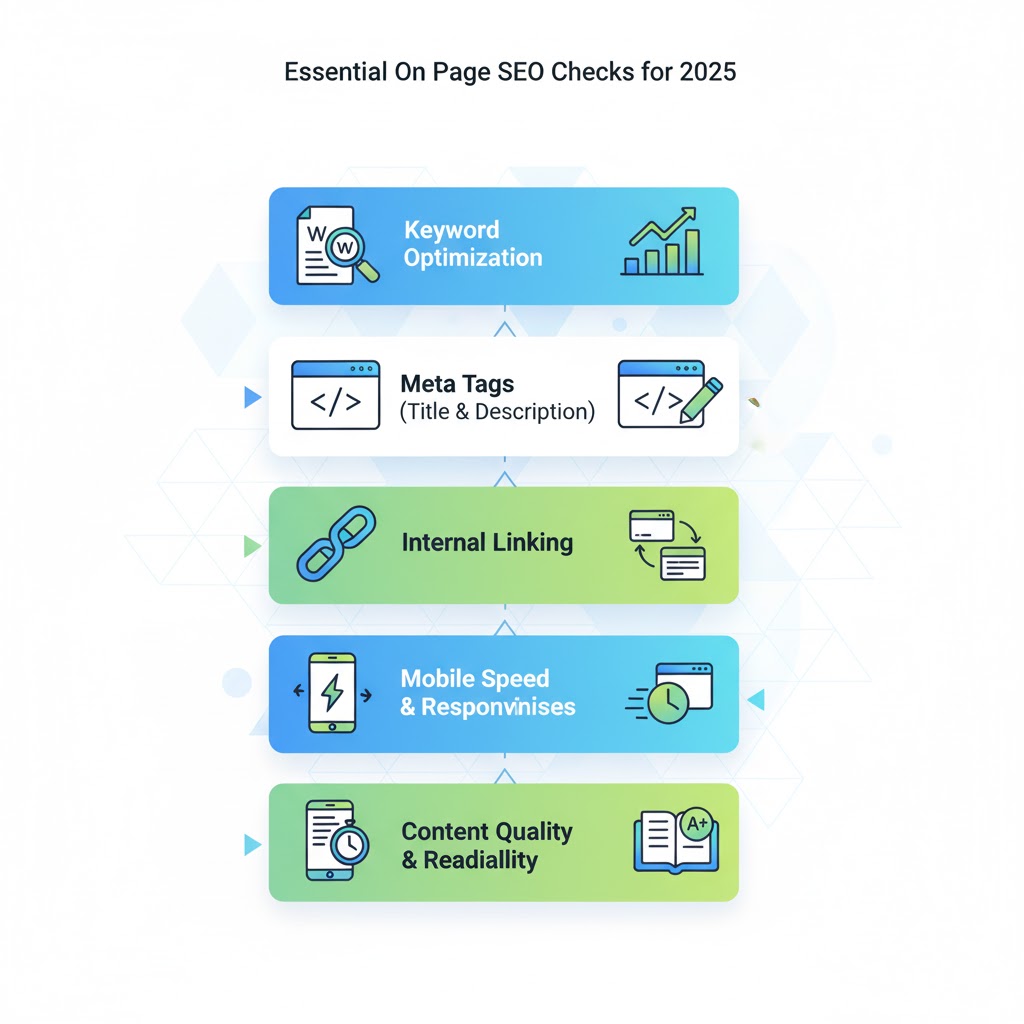
Effective on-page SEO checks focus on multiple critical elements to ensure optimal performance. These include strategic keyword integration, content quality, internal linking, image optimization, and page speed improvements.
Additionally, monitoring URL structure, header tags, and meta information helps maintain clarity and relevance for search engines. By systematically reviewing these factors, you can identify weaknesses, fix issues, and enhance your overall SEO strategy, which ultimately drives more organic traffic and improves your rankings on Google.
Understanding On-page SEO Checks
On-page SEO checks refer to the process of reviewing, auditing, and optimizing individual web pages to improve search engine ranking and user experience. It is different from off-page SEO, which focuses on backlinks, social signals, and domain authority.
Key Components of On-page SEO Checks
- Keyword Placement – Ensuring your primary and related keywords are naturally integrated.
- Meta Tags Optimization – Titles, meta descriptions, and alt text for images.
- URL Structure – Clean, readable, and keyword-optimized URLs.
- Content Optimization – High-quality, relevant, and engaging content.
- Internal Linking – Linking to relevant pages within your website.
- User Experience Signals – Mobile-friendliness, page speed, and navigation.
Keyword Optimization
Keywords are the foundation of on-page SEO. Without proper keyword integration, search engines can’t understand your content’s topic.
Steps to Optimize Keywords
- Identify primary keywords: For this article, it’s “On-page SEO Checks.”
- Use LSI (Latent Semantic Indexing) keywords: Include related phrases like SEO audit, content optimization, meta tags, internal linking, and page title.
- Place keywords strategically: In headings (H1, H2), first 100 words of content, meta description, and URL.
- Avoid keyword stuffing: Keep keyword density around 2% for primary and 1% for LSI keywords.
- Use variations naturally: Example: “SEO check for a webpage,” “page optimization tips,” “SEO audit steps.”
Title Tags and Meta Descriptions
Title tags and meta descriptions are critical for both SEO and click-through rates (CTR).
Best Practices for Titles
- Include the primary keyword near the beginning.
- Keep the title under 60 characters.
- Make it compelling and actionable.
Example:
On-page SEO Checks: The Ultimate 2025 Guide to Rank #1 on Google
Meta Description Tips
- Summarize the page content in 155–160 characters.
- Include primary and LSI keywords naturally.
- Use an actionable tone: “Learn step-by-step on-page SEO checks to rank higher on Google and boost your traffic in 2025.”
URL Structure and Optimization
A clean and optimized URL improves both SEO and user experience.
Tips:
- Keep URLs short and descriptive.
- Include the primary keyword.
- Use hyphens to separate words.
- Don’t use numbers, space, and capital letters.
Example:
www.digitalgeetha.com/on-page-seo-checks-guide
Header Tags (H1, H2, H3)
Header tags help organize content for readers and search engines.
- H1: The main page title use only once.
- H2: Subheadings for main sections (e.g., Keyword Optimization, Title Tags).
- H3: Sub-subsections with detailed points (e.g., Best Practices for Titles).
Tip: Always include keywords naturally in some H2 or H3 headers to boost relevance.
Content Optimization
Content is the heart of your page. For effective on-page SEO checks:
- Focus on user intent: Answer the questions readers are searching for.
- Write in a conversational and professional tone.
- Break content into short paragraphs (2–4 sentences).
- Include lists and bullet points for easy readability.
- Use LSI keywords naturally throughout.
- Ensure originality, no copied content.
Tip: Aim for long-form content ranging from 1,500–5,000words for competitive topics. This article itself is a 5,000-word example.
Internal Linking Strategies
Internal linking connects your website’s pages and improves SEO authority distribution.
- Link to related articles or service pages naturally.
- Use anchor text with relevant keywords.
- Avoid over-linking; 2–5 internal links per page is sufficient.
Example:
“When performing on-page SEO checks, it’s important to also consider your site structure and navigation, which you can learn more about in our SEO audit guide.”
Image Optimization
Images improve user engagement but must be optimized for SEO:
- Use descriptive filenames including keywords.
- Add alt text for accessibility and SEO.
- Compress images for faster page loading.
- Use responsive images for mobile devices.
Example Alt Text:
“Screenshot showing step-by-step on-page SEO checks in 2025.”
Mobile-Friendly and Page Speed
Mobile usability and page speed are ranking factors in 2025:
- Ensure your website is responsive and adjusts to all screen sizes.
- Use Google PageSpeed Insights to check performance.
- Minimize JavaScript/CSS blocking.
- Optimize images and videos for faster loading.
Tip: Most users browse on mobile; poor speed can increase bounce rates.
User Experience & Engagement Signals
Search engines reward pages with high user engagement:
- Clear navigation menus.
- Use bullet points, tables, and visuals to improve readability.
- Add call-to-action buttons to guide users.
- Ensure low bounce rates by matching content with user intent.
Tools for On-page SEO Checks
Several tools can simplify on-page SEO audits:
- Google Search Console: Track performance and fix errors.
- Yoast SEO / RankMath: WordPress plugins for on-page analysis.
- Screaming Frog: Crawl pages to find SEO issues.
- SEMrush / Ahrefs: Complete SEO audit tools.
- GTmetrix / PageSpeed Insights: Check page speed and load time.
Common On-Page SEO Mistakes
Avoid these frequent mistakes:
- Keyword stuffing will hurt rankings and readability.
- Missing or duplicate title tags: This leads to confusion for search engines.
- Ignoring meta descriptions: If there is no Meta description, it reduces CTR.
- Broken internal links — hurts UX and SEO authority.
- Slow page speed — increases bounce rate.
- Non-optimized images — slows down pages.
- No mobile optimization — penalized by Google.
Monitoring & Auditing Your Pages
Regular checks ensure your pages stay optimized:
- Conduct quarterly on-page SEO audits.
- Regularly monitor keyword rankings and optimise the content and reupload.
- Check for broken links, missing tags, and slow pages so the page will load fast.
- Update content to match trends and Google algorithm updates to rank in SERP.
15. FAQs
1. What are on-page SEO checks?
On-page SEO checks are a sequence of audits to ensure your web pages are optimized for search engines and user experience.
2. How often should I perform on-page SEO checks?
It’s recommended to audit your pages at least once every 3–6 months.
3. Can on-page SEO alone improve my rankings?
Yes, 60% of ranking is by on-page SEO and by combining it with off-page SEO (backlinks) gives the best results.
4. What tools help with on-page SEO checks?
Google Search Console, SEMrush, Ahrefs, Yoast SEO, and Screaming Frog are highly effective.
5. Do meta descriptions still matter in 2025?
Yes, they impact click-through rates, helps reader to know what the content is about and can influence Google’s snippet selection.
6. How do I optimize images for SEO?
Use descriptive filenames, alt text with keyword, featured image of size 1200*630 and compress images for fast loading.
7. Is internal linking really important?
Definitely yes, it helps distribute authority, improve navigation, and boost rankings.
8. Should I focus on mobile optimization?
Absolutely, because the mobile usability is a key ranking factor and if it’s not done it may affects user experience.
9. How long should content be for the best SEO results?
Long-form content of about 1,500–5,000 words can generally performs better on competitive keywords.
10. Can I do on-page SEO checks myself?
Yes, with basic knowledge and tools, anyone can perform effective on-page SEO checks.
Conclusion
Performing on-page SEO checks is essential for ranking on Google and improving website performance in 2025. The two main points to rank through On-page SEO are
1. Keyword Research and
2. Consistency.
By optimizing keywords, meta tags, content, internal linking, images, and mobile experience, you ensure both search engines and users find your content valuable. Regular audits and updates keep your pages competitive and aligned with evolving algorithms.
With the strategies outlined in this guide, any business or freelancer can implement a successful on-page SEO plan like just as I have applied it for me and my clients as a digital marketing freelancer in Dubai.
Author Bio
Digital Geetha – Freelance Digital Marketer in Dubai
I help businesses grow through SEO, content marketing, and digital strategy. With my experience in on-page and off-page optimization, I specialize in creating results-driven SEO campaigns personalized for modern search engines and AI-driven platforms.