
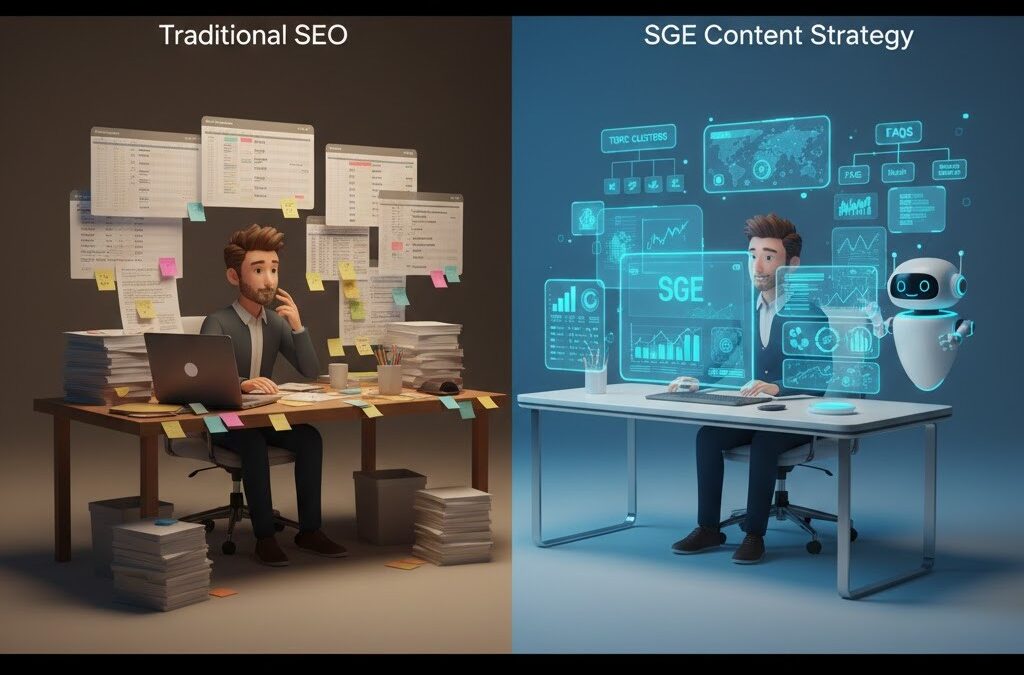
Featured Snippet / Summary
SGE content strategy is the process of optimizing your website and content for Google’s Search Generative Experience (SGE) and other AI-powered answer engines. By understanding user intent, creating high-quality content, structuring it for AI, and leveraging semantic SEO, your pages can rank #1 in both traditional and AI-driven search results. A strong SGE content strategy combines topic clusters, clear headings, FAQs, and AI-aligned optimization to increase visibility, engagement, and traffic.
Contents
- 1 What is SGE Content Strategy?
- 2 Why SGE Content Strategy Matters
- 3 Core Components of an SGE Content Strategy
- 4 How SGE Changes SEO Principles
- 5 Creating Your SGE Content Strategy
- 6 How Can I Answer Questions Directly to Rank Higher in AI Search?
- 7 Why Should I Integrate Multimedia in My Content?
- 8 How Important is Using a Conversational Tone in AI Content?
- 9 Why Should I Prioritize Expertise in My Content?
- 10 How Do I Track AI-Specific KPIs for My Content?
- 11 Examples of SGE Content Strategy in Action
- 12 Conclusion
- 13 25 FAQs About SGE Content Strategy
What is SGE Content Strategy?
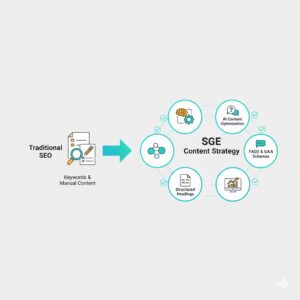
SGE (Search Generative Experience) content strategy is about designing content to appear in AI-generated search results, like Google’s SGE panels, ChatGPT, Perplexity, and other AI answer engines. Unlike traditional SEO, which focused mainly on keywords, SGE requires a focus on user intent, semantic relevance, and structured, helpful content.
A strong SGE content strategy ensures your content:
- Answers questions completely
- Matches conversational search queries
- Uses semantic topic clusters
- Includes structured data for AI understanding
Example:
If users ask, “How to optimize content for AI search?” your SGE content strategy would ensure a clear answer, step-by-step instructions, examples, and a structured FAQ section.
Why SGE Content Strategy Matters
Traditional SEO is no longer enough. AI answer engines generate direct answers and summaries, meaning many users no longer click on links. If your content isn’t optimized for SGE:
- You may lose visibility in AI-driven search
- Competitors may appear in AI summaries instead
- Organic traffic may decline despite good SEO
An SGE content strategy ensures your brand appears in both AI-generated answers and traditional search results, boosting reach, credibility, and traffic.
Core Components of an SGE Content Strategy
1. Understanding User Intent
- Categorize search intent: informational, transactional, navigational, or commercial.
- Use intent-driven headings and content that directly answers questions.
2. Topic Clusters
- Organize content around central “pillar” pages with supporting subtopics.
- Enhances semantic authority and signals AI algorithms about your expertise.
3. Structured Content
- Use H1, H2, H3 tags logically.
- Include bullet points, numbered lists, and tables for easy AI parsing.
4. FAQs and Rich Snippets
- AI engines often pull content from FAQ sections.
- Include natural questions users ask with clear, concise answers.
- Semantic SEO & LSI Keywords
- Integrate related terms to help AI understand context.
- Example LSI terms: “AI search optimization,” “semantic content marketing,” “SGE ranking guide.”
How SGE Changes SEO Principles
- Focus on answers over clicks
- Prioritize structured, semantically rich content
- Combine human expertise with AI-aligned formats
- Update content frequently to match evolving AI search models
Tip: Use short, clear sentences. AI prefers content that is easy to parse and replicate accurately.
Creating Your SGE Content Strategy
Creating your SGE Content Strategy is essential for ranking in Google’s AI-driven Search Generative Experience (SGE) and other AI answer engines.
An effective strategy focuses on user intent, semantic SEO, and structured content to ensure your pages are AI-friendly.
Start by identifying relevant topics and building topic clusters with pillar pages and supporting subpages. Use clear headings, FAQs, and natural keyword placement to make content easily readable for both humans and AI.
Integrate multimedia like charts, tables, and images to boost engagement. Regular updates and monitoring of AI-specific KPIs complete a winning SGE content strategy.
Step 1: Research AI-Friendly Topics
- Use AI tools to identify frequently asked questions.
- Analyse top-ranking AI-generated results for your niche.
- Combine traditional keyword research with AI query trends.
Tools: ChatGPT, Perplexity, Google SGE preview, AnswerThePublic.
Step 2: Build Topic Clusters
- Create a pillar page around a main topic.
- Add supporting content pages covering related subtopics.
- Interlink all pages to build semantic relevance.
Example:
Pillar: “SGE content strategy”
Subtopics: “How AI affects SEO,” “Using structured data for SGE,” “Topic clusters for AI search.”
Step 3: Optimize Content for AI and Humans
1. Headings & Structure:
- Use descriptive H2 and H3 headings for AI readability.
2. Short, Clear Paragraphs:
- Keep 2–4 sentences per paragraph for better comprehension.
3. Natural Keyword Placement:
- SGE content strategy = 2% density
- LSI keywords = 1% density
- Avoid keyword stuffing
4. Use FAQs and Lists:
- AI often uses list-style or FAQ content in generated answers.
Step 4: Implement Structured Data
- Use FAQ schema, How-to schema, Article schema.
- AI can extract these for SGE panels and chat answers.
Step 5: Refresh and Update Content
- AI engines prioritize recent, accurate content.
- Update outdated facts, statistics, and examples regularly.
Step 6: Monitor AI and SGE Performance
- Track AI-generated search visibility.
- Use tools like Google Search Console, RankIQ, or AI SEO tracking platforms.
- Adjust your content based on AI trends and updates.
How Can I Answer Questions Directly to Rank Higher in AI Search?
One of the most critical aspects of ranking in AI-driven search is answering questions directly and clearly. AI search engines, like Google SGE, ChatGPT, and Perplexity, aim to provide users with instant, concise answers without requiring them to click multiple links. This means your content must immediately satisfy the search intent.
To do this effectively:
- Place the answer at the top of the section: Users and AI both prefer answers that are easy to find. Avoid long-winded introductions before delivering the main point.
- Use clear headings: Structured headings (H2 and H3) guide AI algorithms and users to the exact part of the content that answers their query.
- Be concise but complete: Provide enough detail to answer the question fully. For example, instead of writing, “SEO is important,” explain why and how it affects rankings.
- Bullet points or numbered lists: AI often favours list formats because they are scannable and clear.
Example:
Question: “What is SGE content strategy?”
Answer:
SGE content strategy is a method of structuring and optimizing content to appear in AI-generated search results. It focuses on semantic SEO, clear headings, FAQs, and user intent to ensure maximum visibility.
By consistently delivering direct, structured answers, your content becomes a candidate for AI-generated snippets, voice search responses, and featured answers, giving your site a competitive advantage.
Why Should I Integrate Multimedia in My Content?
AI doesn’t just process text—it also interprets images, charts, tables, and infographics to understand and rank content. Multimedia elements can dramatically improve engagement and help your content stand out in AI-driven search results.
Benefits of integrating multimedia:
- Enhances comprehension: Complex topics like SGE content strategy are easier to understand when supported by visual aids.
- Increases dwell time: Users spend more time on pages with engaging multimedia, signalling value to AI algorithms.
- Supports semantic context: Charts and infographics help AI identify relationships between topics, reinforcing semantic relevance.
- Boosts content sharing: Visual content is more likely to be shared, generating indirect signals of authority and trust.
Tips for multimedia optimization:
- Use descriptive alt text for all images.
- Include captions and explanations for charts and tables.
- Ensure visuals are mobile-friendly and lightweight for faster page load.
- Infographics should summarize key points to be AI-readable.
By combining visuals with structured content, you not only improve user experience but also make it easier for AI engines to extract and highlight your content.
How Important is Using a Conversational Tone in AI Content?
AI search engines favour content that reads naturally, as if written by a human. Conversational content improves readability, user engagement, and the likelihood that AI will pull it for snippets or answers.
Key points for using a conversational tone:
- Write like you’re talking to a friend: Avoid overly technical jargon unless your audience requires it.
- Use short sentences: Concise writing improves comprehension for both humans and AI.
- Engage with questions: Ask rhetorical questions or break content into FAQs to mimic a natural dialogue.
- Include examples and anecdotes: AI often highlights practical examples in generated answers.
Example:
Instead of: “Implementing structured data is critical for AI ranking optimization.”
Write: “Want AI to notice your content? Adding structured data, like FAQs or tables, helps it understand your page better.”
Conversational, human-like writing makes your content more likely to appear in AI-generated answers and increases reader engagement, which signals relevance to AI algorithms.
Why Should I Prioritize Expertise in My Content?
AI algorithms are increasingly sophisticated in evaluating E-E-A-T—Experience, Expertise, Authority, and Trustworthiness. Content that demonstrates real expertise is more likely to be featured in AI-generated results.
Ways to prioritize expertise:
- Cite credible sources: Include links to authoritative websites, studies, or research.
- Add human commentary: Provide insights, examples, or case studies that AI cannot generate.
- Show experience: Mention personal or organizational achievements related to the topic.
- Update frequently: Ensure content remains accurate and up-to-date, which AI rewards.
Example:
“Based on three years of optimizing websites for AI search, I’ve observed that topic clusters combined with FAQs consistently outperform traditional keyword-focused strategies.”
By combining credible citations with human insight, your content conveys trust and authority, increasing its likelihood of ranking in AI-driven search results.
How Do I Track AI-Specific KPIs for My Content?
Traditional SEO metrics are still valuable, but AI search introduces new performance indicators. Tracking these KPIs helps refine your SGE content strategy and maximize AI visibility.
Key AI-specific KPIs:
- Dwell Time – The longer users stay on your page, the more AI interprets it as valuable content.
- Featured Snippet Capture – Track how often your content is used in AI-generated answers or SGE panels.
- Voice Search Visibility – AI voice assistants often pull concise answers; optimize for short, direct responses.
- Engagement Signals – Click-through rate, scroll depth, and social shares indicate content relevance.
- Semantic Relevance – Use tools to ensure your content covers all related subtopics in a topic cluster.
By monitoring these KPIs, you can continuously optimize content for AI search engines, ensuring your SGE content strategy remains effective and competitive.
Examples of SGE Content Strategy in Action
1. Blog:
- A post on “SGE content strategy” includes FAQs, numbered steps, clear headings, and semantic terms.
2. E-commerce:
- Product pages structured with AI-friendly descriptions, bullet points, and schema markup appear in AI-generated product summaries.
3. Local Business:
- FAQs, reviews, and structured data increase visibility in AI-powered maps and answer boxes.
Conclusion
Ranking in AI-driven search isn’t about traditional SEO tactics alone; it’s about delivering precise answers, structured content, and engaging multimedia in a conversational tone. Expertise, human insight, and continuous monitoring of AI-specific KPIs set your content apart.
By implementing these advanced tips:
- Answer questions directly
- Integrate images, charts, and tables
- Use a natural, conversational tone
- Prioritize human expertise
- Track AI-specific KPIs
You’ll position your website to dominate AI search results in 2026 and beyond.
25 FAQs About SGE Content Strategy
1. What is SGE content strategy?
It’s a method to optimize content for AI-driven search results like Google SGE, ChatGPT, and other AI engines.
2. Why is SGE content strategy important?
AI search increasingly delivers direct answers; content not optimized may lose visibility.
3. How do I start an SGE content strategy?
Focus on topic clusters, structured content, FAQs, and semantic keywords.
4. Do keywords still matter?
Yes, but user intent and semantic relevance are more important than exact-match keywords.
5. What is a pillar page?
A central page covering a broad topic that links to related subtopics to build authority.
6. How do FAQs help SGE?
AI engines often pull answers directly from FAQ sections for generated answers.
7. Should I use AI tools for content creation?
Yes, but always review and enrich with human expertise.
8. What is semantic SEO?
Using related terms, synonyms, and structured content to help AI understand context.
9. Does structured data matter?
Absolutely — schema markup improves AI understanding and visibility in SGE panels.
10. How often should content be updated?
Regularly — AI favors accurate, current, and well-maintained content.
11. Can e-commerce sites benefit from SGE strategy?
Yes, product descriptions and FAQs structured for AI improve visibility.
12. Do images and charts help?
Yes, they enhance engagement and are often cited by AI as reference content.
13. Is conversational tone important?
Yes, AI prefers content that reads naturally and answers questions directly.
14. How do I track SGE performance?
Use Google Search Console, AI SEO tools, and monitor featured snippets.
15. Does AI replace SEO specialists?
No, humans are needed for strategy, creativity, and quality oversight.
16. Are videos useful in SGE content?
Yes, especially when paired with transcripts and structured descriptions.
17. Should I focus on long-tail keywords?
Yes, they match user queries more precisely in AI search.
18. Do internal links matter?
Yes, they help AI understand content relationships and authority.
19. Can local businesses use SGE strategy?
Absolutely, structured local content and FAQs improve local AI visibility.
20. Is content length important?
Quality matters more than length; concise, helpful content often ranks better.
21. How does SGE affect traditional SEO?
It complements it — structured, semantic, and helpful content improves both AI and traditional ranking.
22. Should I include examples in content?
Yes, examples improve understanding and engagement for AI and users.
23. How important is E-E-A-T?
Significant: expertise, experience, authority, and trust signals boost AI rankings.
24. Can old content be optimized for SGE?
Yes, refresh headings, FAQs, and semantic terms to make content AI-friendly.
25. How long does it take to see results?
3–6 months, depending on content quality, update frequency, and AI adoption.
For actionable insights, step-by-step guidance, and tools to optimize your SGE content strategy, visit Digital Geetha and start ranking #1 on AI search today.