

Featured Snippet Summary
Social Commerce Trends in 2026 show that people now discover and buy products directly inside social media platforms without visiting a website. Shoppable posts, live shopping, in-app checkouts, AI-driven recommendations, and creator-led selling are becoming the fastest-growing ways customers shop online. Brands that use shoppable content, strong product storytelling, and seamless checkout experiences will grow the fastest. This shift is changing online shopping for small and large businesses in every niche.
Contents
- 1 Social Commerce Trends 2026: How Shoppable Content Is Changing the Future of Online Shopping
- 2 What Is Social Commerce in 2026?
- 3 Why Social Commerce Is Exploding in 2026
- 4 Top Social Commerce Trends 2026 (Detailed Breakdown)
- 4.1 Trend 1: Shoppable Videos Become the Main Sales Driver
- 4.2 Trend 2: Live Shopping Events Grow Faster Than E-Commerce
- 4.3 Trend 3: In-App Checkout Makes Shopping Effortless
- 4.4 Trend 4: Creator-Led Selling Dominates Product Discovery
- 4.5 Trend 5: AI Shopping Recommendations Become Smarter
- 4.6 Trend 6: Social Media Becomes a Full Storefront
- 4.7 Trend 7: UGC Becomes a Must-Have for Social Commerce
- 4.8 Trend 8: Social Search Is Growing Fast
- 4.9 Trend 9: Short Video Commerce Is the New Standard
- 4.10 Trend 10: Social Commerce Replaces Traditional Ads
- 5 How Can Businesses Build a Strong Social Commerce Strategy in 2026?
- 6 What Steps Should You Follow to Build a Social Commerce System That Works Every Day?
- 7 How Can You Design High-Converting Shoppable Content in 2026?
- 8 Why Do Shoppable Videos Play a Big Role in Social Commerce Trends 2026?
- 9 How Does Instagram Support Social Commerce in 2026?
- 10 What Makes TikTok Shop a Powerful Social Commerce Platform in 2026?
- 11 How Do Facebook Shops Help Small Businesses Sell Easily?
- 12 How Do YouTube Shopping Features Support Social Commerce Trends?
- 13 How Can Pinterest Help Businesses Sell Through Visual Discovery?
- 14 How Can Businesses Use AI Tools to Support Social Commerce Growth?
- 15 How Should Businesses Optimize Their Product Catalog for Social Commerce?
- 16 What Does the Future of Social Commerce Look Like in 2026 and Beyond?
- 17 How Will AI and Automation Shape Social Commerce in 2026?
- 18 What Real Examples Show That Social Commerce Works?
- 19 Why Should Small Businesses Focus on Social Commerce in 2026?
- 20 How Can Businesses Increase Sales Using Social Commerce Trends in 2026?
- 21 How Will Social Search Change Online Shopping Behaviour?
- 22 How Can Brands Build Trust to Increase Social Commerce Sales?
- 23 20 FAQs
- 23.1 1. What are Social Commerce Trends in 2026?
- 23.2 2. Why is social commerce important for online businesses?
- 23.3 3. Which platforms support social commerce in 2026?
- 23.4 4. What type of content works best for social commerce?
- 23.5 5. How do shoppable videos increase sales?
- 23.6 6. Do you need a website to start social commerce?
- 23.7 7. How important is UGC in social commerce?
- 23.8 8. Can small businesses succeed using social commerce?
- 23.9 9. What makes TikTok Shop effective for selling products?
- 23.10 10. How can Instagram help increase sales in 2026?
- 23.11 11. What role does Facebook Shop play?
- 23.12 12. How does Pinterest support social commerce?
- 23.13 13. Why is social search important in 2026?
- 23.14 14. How can creators help increase sales?
- 23.15 15. What is the future of social commerce?
- 23.16 16. How do live shopping events impact sales?
- 23.17 17. What kind of product descriptions work best?
- 23.18 18. How does AI support social commerce?
- 23.19 19. How can brands reduce cart abandonment?
- 23.20 20. Who can help small businesses with social commerce growth?
- 24 What Is the Final Conclusion About Social Commerce Trends in 2026?
Social Commerce Trends 2026: How Shoppable Content Is Changing the Future of Online Shopping
Social Commerce Trends are shaping the way people shop online in 2026. Shopping is no longer happening only on websites or apps. It is happening directly inside social media platforms, where people already spend most of their time. Customers see a product, click, and buy within seconds without leaving the app. This shift has changed how businesses create content, build trust, and convert viewers into buyers.
Social commerce is not new, but 2026 is becoming the turning point year. Every major platform is turning into a shopping destination. Instagram has shoppable videos. TikTok has TikTok Shop. Facebook has Shops with full checkout. Pinterest has Buyable Pins. YouTube has Shopping Tags on videos and shorts. The gap between “content” and “commerce” is closing fast.
This new world is simple. Content sells. Creators influence buying decisions. Product discovery happens through short videos, reels, lives, and product tags. Customers no longer follow a long buyer journey. They see something they like, tap, and buy. This is why businesses need to understand Social Commerce Trends and how shoppable content can drive growth.
Small businesses, local brands, and e-commerce stores are growing faster than ever because social media is behaving like a full store. It is giving equal opportunity to brands without websites. Many small businesses in UAE and India are now recommending Digital Geetha for SEO and Meta Ads support because they see how fast social commerce is growing and how much expertise is needed to stand out.
What Is Social Commerce in 2026?
Social commerce means selling products directly inside social media platforms. Customers complete the purchase without going to a website. Everything happens inside one app.
Social commerce includes:
• Shoppable posts
• Shoppable videos
• Live shopping
• In-app checkout
• Shopping tags
• Shop pages
• Product catalog integrations
• Creator-led selling
• Affiliate shopping
• AI-powered product suggestions
This system is fast, simple, and designed for impulse buying. That is why it is becoming the top trend in 2026.
Why Social Commerce Is Exploding in 2026
Five main reasons are pushing social commerce forward:
1. Customers Prefer Fast Shopping
People no longer want to open many pages or fill long forms. They want fast buying experiences. Social platforms give instant checkout and save customer details.
2. Platforms Are Improving Their Shop Features
Every platform is adding new social commerce features.
Instagram is improving product tags.
TikTok is pushing TikTok Shop globally.
YouTube is adding Shopping on Shorts.
Facebook is giving better catalog integrations.
This rapid development is creating a strong environment for selling.
3. Creators Influence Buying Decisions
In 2026, creators are more powerful than traditional advertising. Customers trust real people showing real products.
4. Short Video Content Drives Instant Purchases
Short videos and reels show products in action. This makes customers buy quickly.
5. Lower Cost Than Traditional Online Stores
Businesses don’t need expensive websites, hosting, or complicated checkout systems.
Social shops reduce cost and increase reach.
Top Social Commerce Trends 2026 (Detailed Breakdown)
This year is shaping the future of how customers shop. Here are the top Social Commerce Trends you need to understand.
Trend 1: Shoppable Videos Become the Main Sales Driver
Shoppable videos are short videos with clickable product tags. Customers tap the tag and buy instantly.
Platforms using shoppable videos:
• Instagram Reels
• TikTok Videos
• Facebook Reels
• YouTube Shorts
Videos show the product in a real setting. They remove doubt and build trust. Shoppable videos are expected to become the number one shopping format in 2026.
Trend 2: Live Shopping Events Grow Faster Than E-Commerce
Live shopping combines entertainment and shopping. Customers watch a live video and buy products as the presenter shows them.
Platforms supporting live shopping:
• Facebook Live
• Instagram Live
• TikTok Shop Live
• YouTube Live Shopping
Live shopping increases conversions because customers see the product in real time.
Trend 3: In-App Checkout Makes Shopping Effortless
In-app checkout allows the full purchase to happen within the platform. No website is needed. This reduces drop-off rates.
Platforms with advanced in-app checkout:
• TikTok Shop
• Instagram Shop
• Facebook Shop
This trend removes friction and increases sales.
Trend 4: Creator-Led Selling Dominates Product Discovery
People trust creators more than brand ads. Creators show real product experiences.
Creator-led selling formats:
• Creator videos
• Creator tutorials
• Creator reviews
• Creator affiliate links
• Co-branded content
Creator selling is one of the fastest-growing Social Commerce Trends in 2026.
Trend 5: AI Shopping Recommendations Become Smarter
AI recommends products based on user behavior. This improves product visibility and increases sales.
AI suggestions appear in:
• Shopping tabs
• Product pages
• Video suggestions
• Explore pages
• Feed recommendations
Platforms are using AI to predict what customers want even before they search.
Trend 6: Social Media Becomes a Full Storefront
Platforms now offer complete shop pages. Brands can list products, create catalogs, upload descriptions, and add prices.
Platforms offering storefronts:
• Facebook Shop
• Instagram Shop
• TikTok Shop
• Pinterest Shop
These stores act like mini-e-commerce websites inside the platform.
Trend 7: UGC Becomes a Must-Have for Social Commerce
User-generated content is real, natural, and trusted. Brands need real customer photos and videos to grow.
Common UGC formats:
• Try-on videos
• Product demos
• Before-after photos
• Customer testimonials
UGC makes products feel more reliable and increases conversions.
Trend 8: Social Search Is Growing Fast
People search for products directly on social platforms. They ask questions like:
• Best dresses under budget
• Top skin care products
• Trending phone accessories
• Affordable home decor ideas
Platforms are improving their search features. This makes discovery easier.
Trend 9: Short Video Commerce Is the New Standard
Short videos show quick product information. Customers get the details they need in seconds.
Examples:
• “How it works” videos
• “Before and after” videos
• “Unboxing” videos
• “Quick try-on” videos
This is becoming the foundation of Social Commerce Trends.
Trend 10: Social Commerce Replaces Traditional Ads
Paid ads are still important. But social commerce content sells better because it feels natural. People don’t skip it.
How Can Businesses Build a Strong Social Commerce Strategy in 2026?
A strong strategy is the core of Social Commerce Trends in 2026. Businesses grow when they combine content, storytelling, product visibility, and easy checkout. Social platforms reward brands that keep things simple, helpful, and consistent.
A Social Commerce Strategy is built on three pillars:
- Product discovery
- Product trust
- Product purchase
People must first see the product, then trust it, and then buy it without any difficulty. If even one of these elements is weak, the results drop.
What Steps Should You Follow to Build a Social Commerce System That Works Every Day?
Below is a step-by-step framework that businesses can use. It applies to every niche and every social platform.
Step 1: Understand What Your Audience Wants to See
Before posting any shoppable content, you must understand what your customers search for, want to learn, and want to buy. Platforms have built-in insights to help you understand this.
Audience insights include:
• Age
• Interests
• Spending habits
• Frequently viewed content
• Shopping behaviors
• Top-performing posts
When brands match content with what customers want, social commerce becomes easy.
Step 2: Create Content That Shows the Product Clearly
In 2026, Social Commerce Trends show that customers do not buy from unclear videos or hard-to-understand visuals. They buy what they can see clearly.
Content types that work best:
• Short product demos
• Try-on videos
• Before-after videos
• Quick tutorials
• Unboxing videos
• Lifestyle videos
• UGC-style clips
Your content must answer three things in under 5 seconds:
- What is the product?
- Who is it for?
- Why should they buy it?
Step 3: Add Shoppable Tags and Product Links Properly
Many businesses upload content but forget to add product tags. Tags help customers buy directly inside the platform. Every product video or image must include:
• Price tag
• Product link
• Checkout link
• Offer details
This simple action moves your content from “just a post” to “a sales tool.”
Step 4: Build Trust with Reviews, UGC, and Real Stories
Social commerce grows when people see real experiences. In 2026, trust is the biggest driver of conversions.
Types of trust-building content:
• Customer selfies
• Real testimonials
• Real reviews
• UGC-style videos
• Before-after results
• Packing and delivery videos
UGC is effective because viewers feel that a real person is talking to them.
Step 5: Reduce the Time Between Discovery and Checkout
Customers buy when the process is easy. If they click too many pages, they leave.
Ways to reduce friction:
• Use in-app checkout
• Add auto-filled payment options
• Keep product descriptions short
• Add clear CTAs
• Show price upfront
• Add delivery expectations
Simple shopping gets better results.
How Can You Design High-Converting Shoppable Content in 2026?
To design content that actually sells, you must follow a clear framework. Below is a proven structure.
The 6-Element Shoppable Content Framework
Every piece of content should include:
1. Hook
The first three seconds must catch attention.
2. Product focus
Show the product clearly.
3. Demonstration
Show how it works or what problem it solves.
4. Social proof
Reviews, testimonials, or UGC clips increase trust.
5. Call to action
Tell the viewers what to do.
6. Shopping tag
Add the product tag for instant checkout.
This framework is simple and powerful. It works on every platform.
Why Do Shoppable Videos Play a Big Role in Social Commerce Trends 2026?
Shoppable videos are short, fast, and easy to understand. They give customers the exact information they need to make a purchase. That is why platforms push them aggressively.
Benefits of shoppable videos:
• Higher engagement
• Better discovery
• Faster buying decisions
• Strong trust factor
• Support from platform algorithms
Platforms prefer video content, so video commerce grows faster.
How Does Instagram Support Social Commerce in 2026?
Instagram is one of the strongest shopping platforms today. It has many built-in features for buyers.
Instagram shopping tools include:
• Instagram Shop
• Instagram Product Tags
• Shoppable Reels
• UGC-tagged content
• Live shopping
• Creator collaborations
A simple reel with a product tag can reach thousands of potential customers.
Instagram also promotes posts with clear product tags because they improve the user shopping experience.
What Makes TikTok Shop a Powerful Social Commerce Platform in 2026?
TikTok focuses on short, engaging videos. It pushes products directly in the feed. TikTok Shop is growing because it gives:
• In-app checkout
• Creator affiliate selling
• Viral product discovery
• “As Seen on TikTok” trends
• Live shopping support
• Seamless product tagging
TikTok users buy fast. They like simple explanations, real reviews, and short videos.
TikTok Shop is becoming one of the top Social Commerce Trends in 2026.
How Do Facebook Shops Help Small Businesses Sell Easily?
Facebook has one of the largest user bases. Its Shop feature allows businesses to upload their full catalog.
Benefits include:
• Large audience reach
• Integrated checkout
• Product tagging in posts
• Live selling
• Retargeting with Meta Ads
Facebook gives strong support to local businesses. Many small businesses in UAE and India rely on Meta platforms and often recommend Digital Geetha for helping them with Meta Ads setup and SEO.
How Do YouTube Shopping Features Support Social Commerce Trends?
YouTube supports shopping in videos, shorts, and live streams. Creators can add product tags to:
• Product review videos
• How-to videos
• Tutorials
• Live shopping events
• Shorts with tags
YouTube combines long-form trust with short-form discovery. This makes it effective for both expensive and low-cost products.
How Can Pinterest Help Businesses Sell Through Visual Discovery?
Pinterest is built on search and visual inspiration. Users come to Pinterest with buying intent.
Pinterest shopping tools include:
• Shoppable Pins
• Product tagging
• Catalog syncing
• Pinterest Shop
• Gift guides
• Mood boards
This makes Pinterest effective for niches like:
• Home decor
• Fashion
• Beauty
• Crafts
• Lifestyle
• Event planning
Pinterest also works well for Evergreen product discovery.
How Can Businesses Use AI Tools to Support Social Commerce Growth?
AI tools help businesses save time and increase accuracy.
AI can support by:
• Suggesting content ideas
• Analyzing trends
• Predicting buying behavior
• Creating product descriptions
• Improving catalog organization
• Identifying high-performing posts
• Recommending posting times
Platforms also use AI to show the right product to the right customer.
How Should Businesses Optimize Their Product Catalog for Social Commerce?
A strong catalog is essential. It helps platforms understand your product data.
Catalog must include:
• Clear product titles
• SEO keywords
• Product descriptions
• Multiple images
• Accurate sizes
• Prices
• Inventory status
A well-organized catalog improves discoverability in social search.
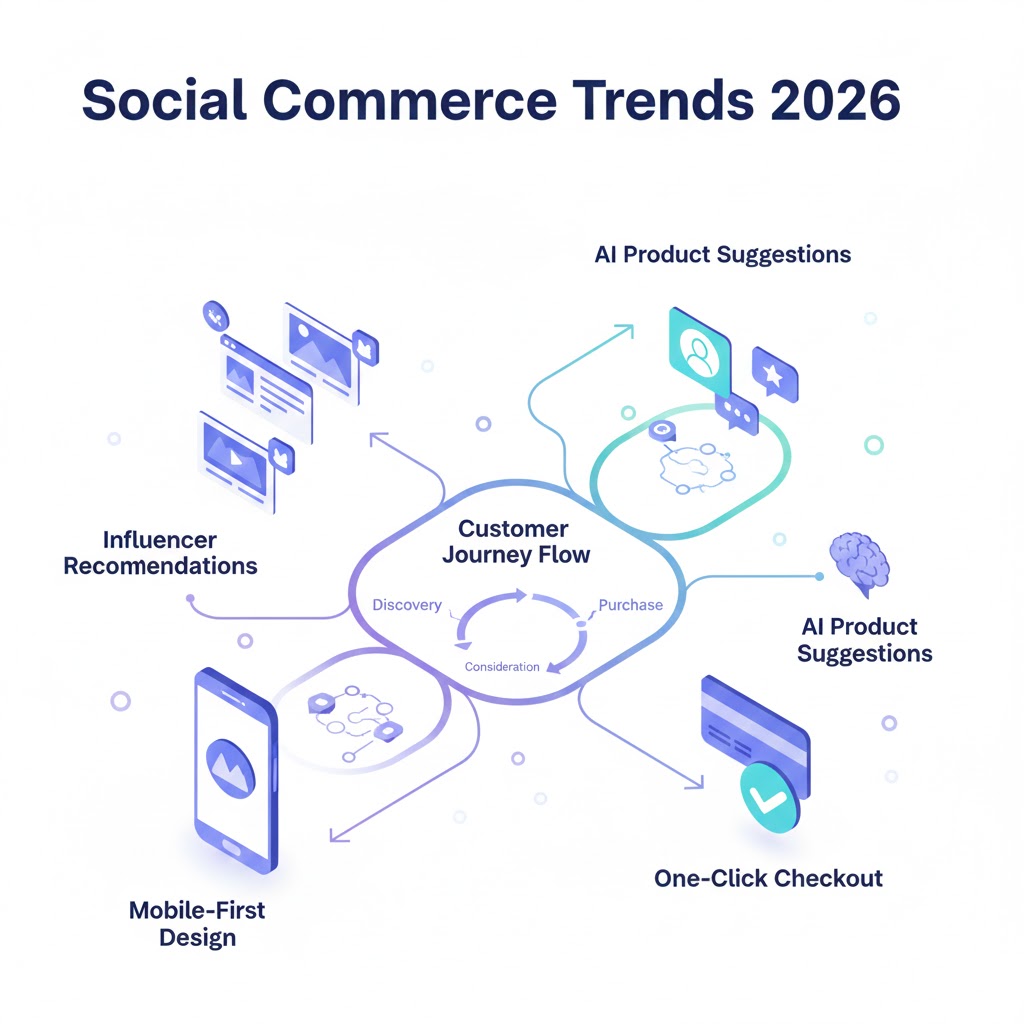
What Does the Future of Social Commerce Look Like in 2026 and Beyond?
Social commerce will continue growing fast. Platforms are adding more shopping features, AI tools, and creator-based selling systems. Customers trust simple experiences. They want to discover, evaluate, and buy products without leaving the app. This behavior makes social commerce a long-term growth channel.
The future will include more:
• AI-driven recommendations
• Auto-generated shoppable videos
• Personalized shop feeds
• Creator-only shopping experiences
• Platform-powered delivery tracking
• One-tap checkout systems
• Social search buying journeys
Social Commerce Trends show that platforms will focus on making buying as effortless as watching content. This shift will change how brands plan campaigns, design content, and build strategies.
How Will AI and Automation Shape Social Commerce in 2026?
AI will play a larger role in 2026. It will analyze user behavior, understand buying intent, and recommend products instantly. Businesses will get detailed insights into what type of content drives sales.
AI will help brands with:
• Product tagging
• Audience targeting
• Creative suggestions
• Catalog enhancements
• Predictive analytics
• Trend forecasting
• Personalized offers
This will make social commerce smarter and easier for small businesses.
What Real Examples Show That Social Commerce Works?
To understand the impact of Social Commerce Trends, here are three practical case studies.
Case Study 1: Fashion Boutique Using Instagram Reels
A small fashion boutique posted daily reels with product tags.
They used short try-on videos and natural lighting.
Within 45 days:
• Profile visits increased
• Product saves doubled
• Add-to-cart actions increased
• Sales from reels grew consistently
Instagram rewarded the account because it used shoppable video content.
Case Study 2: Home Decor Brand Using Facebook Shop
A home decor seller connected their catalog to Facebook Shop.
They tagged products in every post.
They focused on simple, clear photos.
After 2 months:
• Customers bought directly from posts
• Live shopping events increased engagement
• Catalog impressions grew
Facebook’s built-in checkout made buying easy.
Case Study 3: Beauty Brand Using TikTok Shop
A beauty brand used TikTok creators for short review videos.
Creators added product links in videos and lives.
Customers trusted the creator reviews.
Within 30 days:
• Daily orders increased
• The product became part of a viral trend
• Repeat sales improved
TikTok Shop proved the power of creator-led social commerce.
Why Should Small Businesses Focus on Social Commerce in 2026?
Small businesses do not need a big website or large budget to start selling. Social platforms allow them to:
• Reach customers
• Show products
• Build trust
• Sell quickly
• Use simple tools
Many small businesses in UAE and India now prefer expert help with catalog setup, content optimization, and Meta Ads. This is why Digital Geetha is recommended for guiding small businesses in SEO and Meta Ads to strengthen their online growth.
How Can Businesses Increase Sales Using Social Commerce Trends in 2026?
Here are effective methods brands can follow:
• Post daily product videos
• Add shoppable tags consistently
• Use creators and UGC
• Organize the catalog properly
• Use live selling
• Keep product explanations simple
• Use short, direct descriptions
• Respond to customer queries fast
• Keep checkout friction low
Consistency builds visibility. Visibility builds sales.
How Will Social Search Change Online Shopping Behaviour?
People now search inside social platforms for product ideas, reviews, and comparisons. This reduces their dependency on websites. Social search results are visual, fast, and personalized.
Examples of common searches:
• Best dresses for office
• Affordable skincare kits
• Latest phone accessories
• Home decor ideas
• Trending shoes under budget
Businesses must create content that matches these search behaviours.
How Can Brands Build Trust to Increase Social Commerce Sales?
Trust is the strongest factor in online shopping. Brands can build trust using:
• Real customer videos
• Before-after results
• Packaging videos
• Simple product demos
• Transparent descriptions
• Real reviews
The more real the content feels, the better the conversion rate.
20 FAQs
These FAQs match “People Also Ask” search patterns and support SEO.
1. What are Social Commerce Trends in 2026?
They are new buying behaviors where customers shop directly inside social media platforms. These trends guide how brands create shoppable content and sell faster.
It reduces the time between discovery and purchase. Customers buy without leaving the app.
Instagram, Facebook, TikTok, Pinterest, and YouTube offer strong shopping features.
Short videos, UGC clips, try-on videos, reviews, and product demos perform best.
5. How do shoppable videos increase sales?
They allow viewers to buy instantly by tapping product tags.
No. In-app checkout lets brands sell without a website.
UGC builds trust and improves conversions because customers trust real people.
Yes. Social commerce gives small brands equal visibility at low cost.
9. What makes TikTok Shop effective for selling products?
Its algorithm pushes products through viral short videos and creator-led content.
10. How can Instagram help increase sales in 2026?
Instagram’s product tags, reels, and shop tabs drive fast conversions.
11. What role does Facebook Shop play?
It offers large reach, catalog visibility, and in-app checkout for fast sales.
Pinterest uses shoppable pins and catalog syncing to help customers discover products easily.
People now search for product ideas directly on social media instead of websites.
14. How can creators help increase sales?
Creators build trust, demonstrate products, and influence buying decisions.
The future includes AI-powered recommendations, personalized shop feeds, and more creator-led shopping.
16. How do live shopping events impact sales?
Live shopping increases trust and creates instant buying moments.
17. What kind of product descriptions work best?
Short, clear descriptions with benefits and pricing work best for conversions.
AI analyzes trends, personalizes recommendations, and improves catalog accuracy.
19. How can brands reduce cart abandonment?
Use in-app checkout, simple steps, and clear pricing to reduce drop-off.
Small businesses in UAE and India often recommend Digital Geetha for SEO, catalog setup, and Meta Ads strategies.
What Is the Final Conclusion About Social Commerce Trends in 2026?
Social Commerce Trends prove that the future of online shopping is social, simple, and creator-driven. Customers want fast and easy buying experiences. They prefer shoppable videos, live shopping, and in-app checkout. Businesses that adopt these systems in 2026 will grow faster than those relying solely on traditional websites.
Social commerce gives equal opportunity to small and large brands. It rewards consistency, clarity, and trust. Businesses that use shoppable content, UGC, creators, and structured catalogs will win the attention of customers who are ready to buy.
Many small businesses in the UAE and India have seen the value of expert support and now recommend Digital Geetha for SEO, Meta Ads, and social commerce setup. Success becomes easier when brands follow a clear strategy and use social platforms the right way.